
Qwen-Coder Explained: Alibaba’s Open-Weight Coding Models
Qwen-Coder is the code-specialized branch of the qwen by alibaba model family, built by Alibaba Cloud’s Qwen team and released with open weights. In practical terms, it’s a line of models for code generation, autocompletion, and bug repair that anyone can download for free from Hugging Face or ModelScope, according to the official Qwen blog.
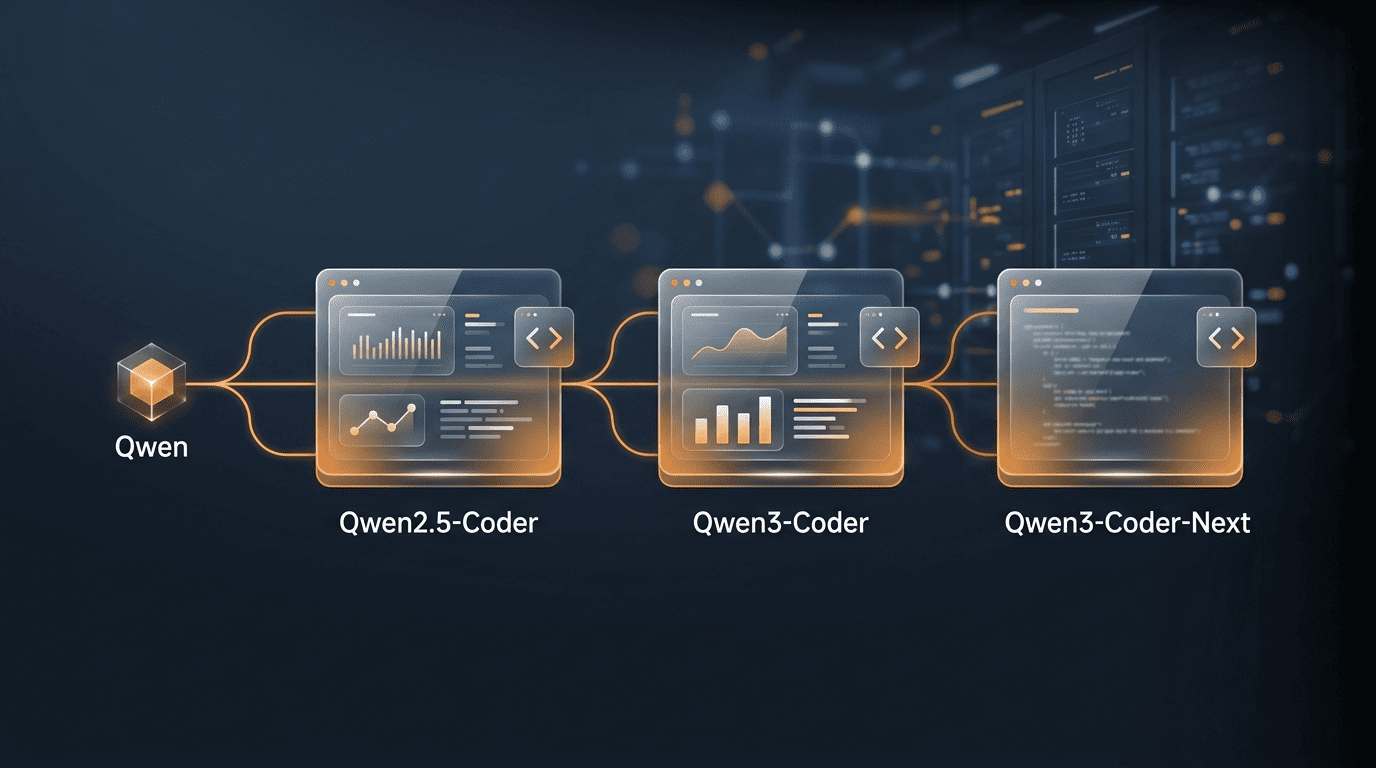
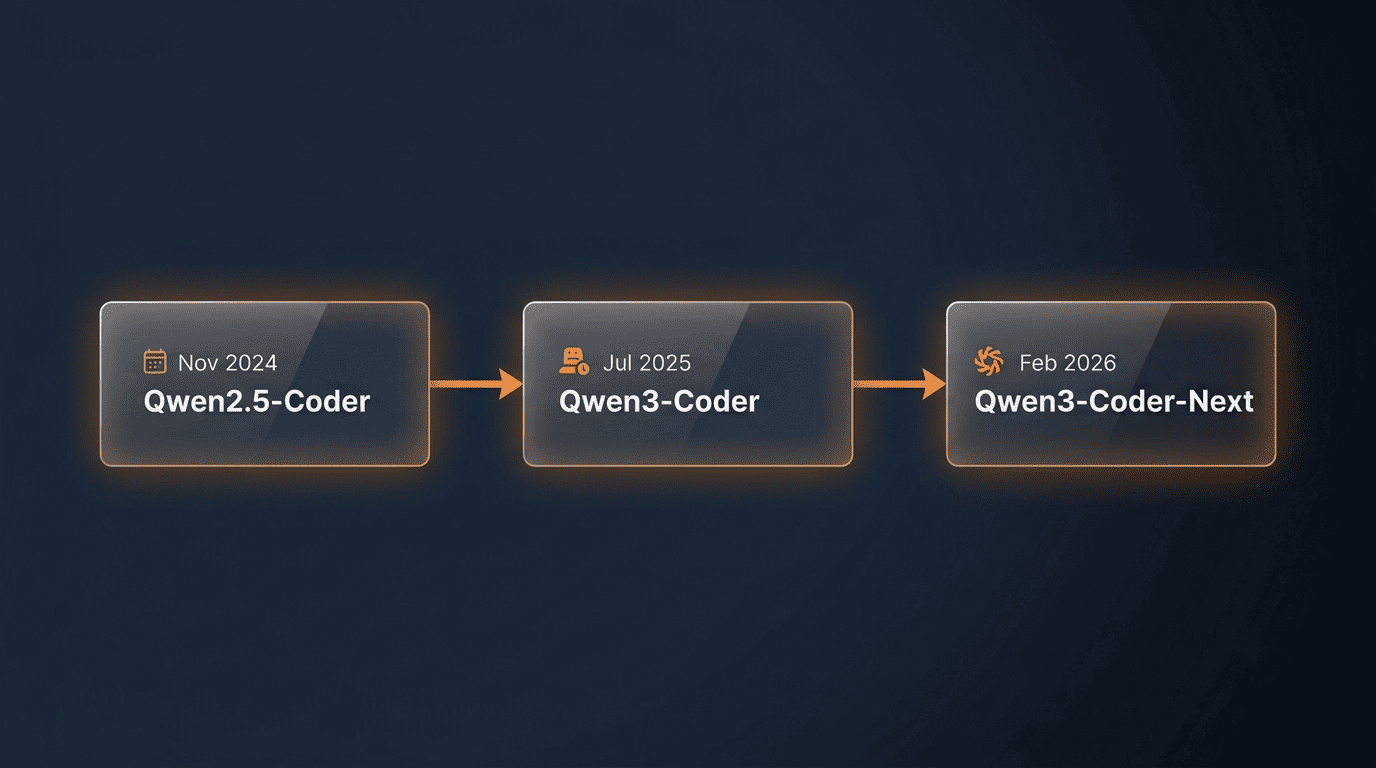
Two generations are active today: Qwen2.5-Coder, released in November 2024, and Qwen3-Coder, released in July 2025, with a further update called Qwen3-Coder-Next arriving in February 2026. This guide covers the sizes on offer, what the models can actually do, their license terms, and where to get them.
Unofficial. This site is not affiliated with, endorsed by, or sponsored by Alibaba or the Qwen team.
What Is Qwen-Coder?
Qwen-Coder is the family of code-specialized large language models built by Alibaba Cloud. Qwen itself — also known by its Chinese name Tongyi Qianwen (通义千问) — is developed by Alibaba Cloud, part of the Alibaba Group, according to Wikipedia. Qwen-Coder is the coding-focused offshoot of that broader family, trained specifically on programming tasks rather than general-purpose chat.
The line didn’t start under the Qwen-Coder name. Alibaba first shipped a code model called CodeQwen1.5 in early April 2024, then folded it into the main Qwen-Coder branding as the next generation arrived. The Qwen team describes that transition directly in their release notes:
Today, we are excited to announce the release of the next generation of open-source coding models, Qwen2.5-Coder, and officially rename CodeQwen to Qwen-Coder.
Qwen Team, Qwen2.5-Coder Series
That single rename is why you’ll still see “CodeQwen” mentioned in older tooling and forum threads even though current documentation only refers to Qwen-Coder, Qwen2.5-Coder, and Qwen3-Coder.
Qwen-Coder Generations: Qwen2.5-Coder, Qwen3-Coder, Qwen3-Coder-Next
Each Qwen-Coder generation is built on top of a corresponding general-purpose Qwen release, then further trained on code. That pattern holds across all three generations released so far.
Timeline and what changed
| Generation | Release date | Based on | Notable |
|---|---|---|---|
| Qwen2.5-Coder | November 2024 | Qwen2.5 | Dense sizes from 0.5B to 32B, trained on 5.5T tokens |
| Qwen3-Coder | July 2025 | Qwen3 | Flagship 480B-A35B MoE plus a smaller Flash 30B-A3B variant |
| Qwen3-Coder-Next | February 2026 | Qwen3-Next-80B-A3B-Base | Coding-focused update built on the Qwen3-Next base |
Qwen2.5-Coder was trained on 5.5 trillion tokens and offers a 128K context window, per the official Qwen blog. Qwen3-Coder moved to a Mixture-of-Experts design and a much larger training run, which the next section breaks down by size. If you’re comparing generations for a specific alibaba qwen models deployment, the release date alone is often the fastest way to tell them apart — Qwen3-Coder-Next is the newest as of this writing.
Model Sizes and Parameters
Qwen2.5-Coder and Qwen3-Coder take different approaches to sizing: one is a ladder of dense checkpoints, the other leans on Mixture-of-Experts (MoE) architecture to scale up without activating every parameter on every request.
Qwen2.5-Coder dense sizes
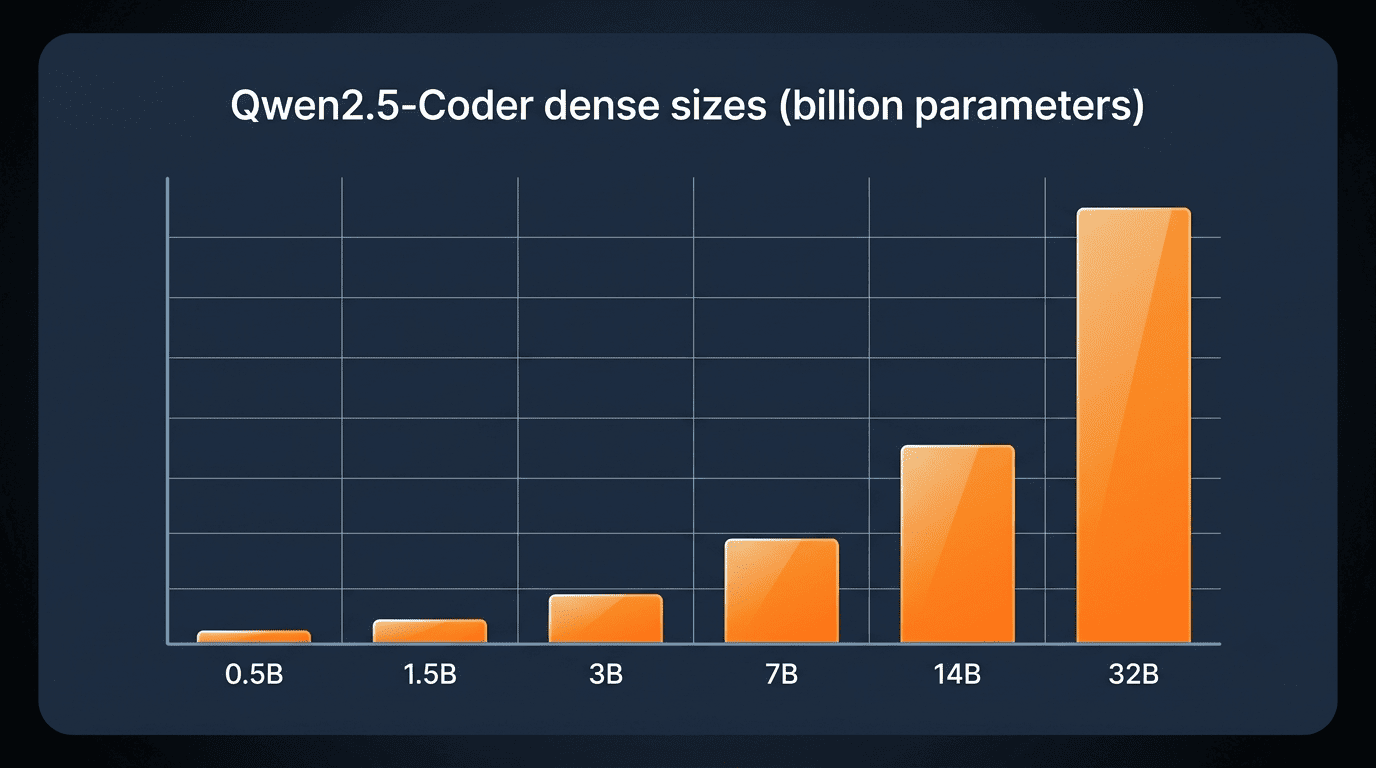
Qwen2.5-Coder ships as six dense checkpoints, each a full standalone model rather than a shared backbone with adapters:
- 0.5B
- 1.5B
- 3B
- 7B
- 14B
- 32B
The 32B-Instruct variant is the flagship of this generation. Its Hugging Face model card lists it at roughly 32.5B total parameters (31.0B excluding embeddings), built from 64 transformer layers with grouped-query attention (GQA), per the Qwen2.5-Coder-32B-Instruct model card.
Qwen3-Coder MoE sizes
Qwen3-Coder switches to Mixture-of-Experts. The flagship, Qwen3-Coder-480B-A35B-Instruct, is a 480B-parameter MoE model that activates 35B parameters per token rather than the full parameter count, according to the Qwen team’s release materials. Alongside it sits a lighter Flash variant, Qwen3-Coder-30B-A3B, aimed at lower-latency or lower-cost deployments. Alibaba has not published every architectural detail for either model beyond these headline figures, so treat anything not sourced to the official blog or GitHub repo as unconfirmed.
What Qwen-Coder Can Do (Code Capabilities)
Across generations, Qwen-Coder targets the same core set of developer tasks, with each new release extending context length and agentic reliability.
Core coding tasks
- Code generation across multiple programming languages
- Code autocompletion, including in interactive IDE sessions
- Fill-in-the-middle (FIM) completion, where the model fills a gap between existing code before and after the cursor
- Code repair and debugging suggestions
- Agentic, tool-using coding workflows — writing, running, and iterating on code as part of a larger task
Context length
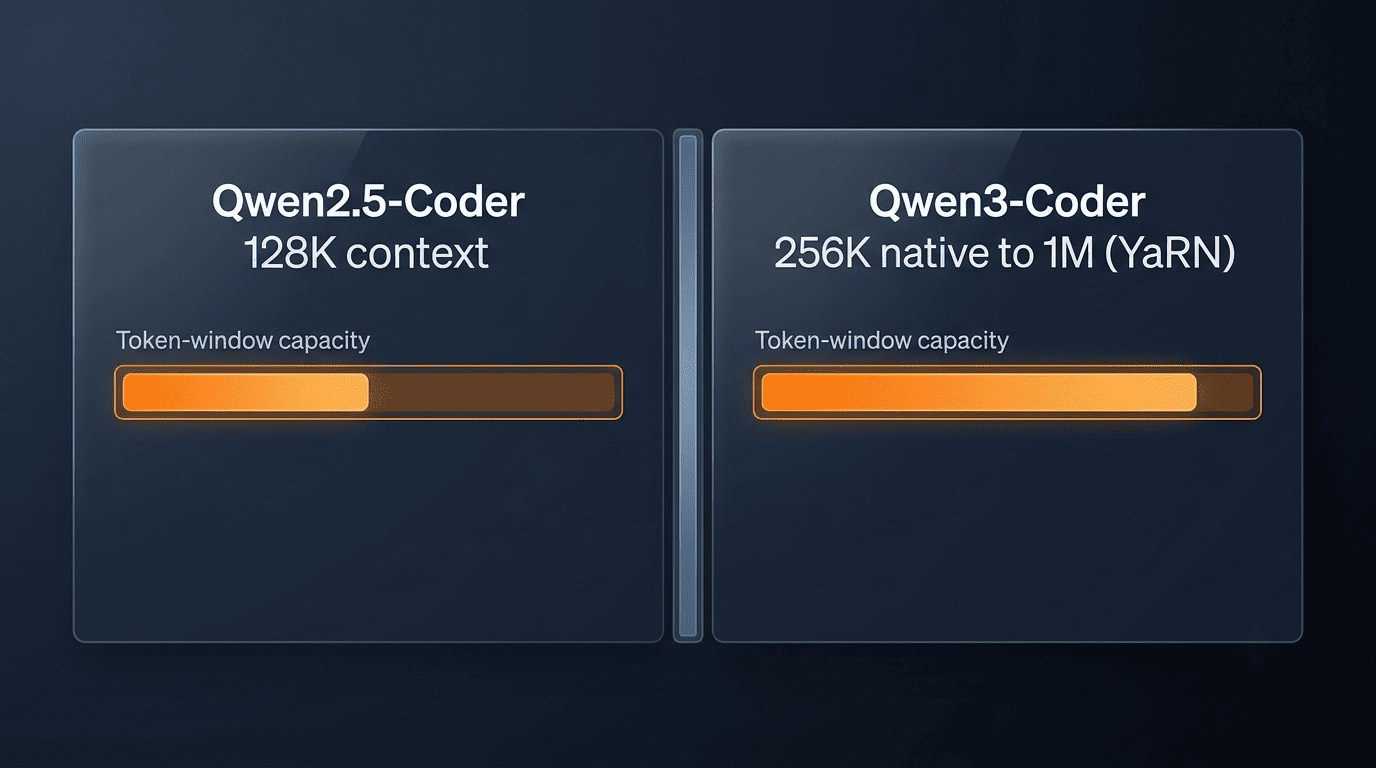
Qwen2.5-Coder supports context windows up to 128K tokens. Qwen3-Coder goes further: 256K tokens natively, extendable up to 1M tokens using YaRN scaling, and it was trained on 7.5 trillion tokens with roughly 70% of that data being code, according to the official Qwen3-Coder blog.
Agentic coding
Qwen3-Coder was specifically trained for agentic coding — multi-step tasks where the model plans, writes, executes, and revises code rather than producing a single completion. Per Qwen’s own release notes, the model was evaluated on agentic coding benchmarks such as SWE-Bench Verified, though exact comparative scores against other models should be checked against the primary source rather than repeated as fixed facts here.
Supported Programming Languages
Language coverage is one of the clearest ways Alibaba has quantified progress between generations, and each figure comes from a specific, attributable source.
Qwen2.5-Coder supports 92 programming languages, according to the official Qwen2.5-Coder blog. Qwen3-Coder-Next extends that considerably: its GitHub README lists support for 358 coding languages, per the QwenLM/Qwen3-Coder repository.
Commonly used languages covered include:
- Python
- JavaScript and TypeScript
- Java
- C++
- Go
- Rust
- SQL
These are representative examples rather than an exhaustive list — the full language set is documented in each model’s release notes, not reproduced in full here to avoid overstating specifics Alibaba hasn’t itemized publicly.
Open Weights and License
Licensing terms vary by model size and generation, so it’s worth checking the specific checkpoint you plan to use rather than assuming one license covers the whole family.
Apache 2.0 covers most sizes. The majority of Qwen-Coder checkpoints, across both the Qwen2.5-Coder and Qwen3-Coder generations, are released under the Apache 2.0 license — a permissive open-source license that allows commercial use, modification, and redistribution.
Some smaller checkpoints use the Qwen Research License instead. Qwen2.5-Coder’s 3B variant, for example, ships under the Qwen Research License rather than Apache 2.0, which restricts usage more than a standard open-source license does.
“Open weights” means the trained parameters are public, not the training pipeline. Alibaba publishes the model weights themselves on Hugging Face and ModelScope so anyone can download and run them, but that’s distinct from open-sourcing the training data, training code, or full methodology behind each release.
Always check the license file on the specific model card on Hugging Face before deploying a Qwen-Coder checkpoint commercially — license terms differ enough between sizes that assuming Apache 2.0 across the board can be a costly mistake.
How to Use Qwen-Coder (IDE, CLI, Agents, API)
There are three broad ways to put Qwen-Coder to work: run the open weights yourself, drive them through a coding CLI or agent, or call Alibaba’s hosted API.
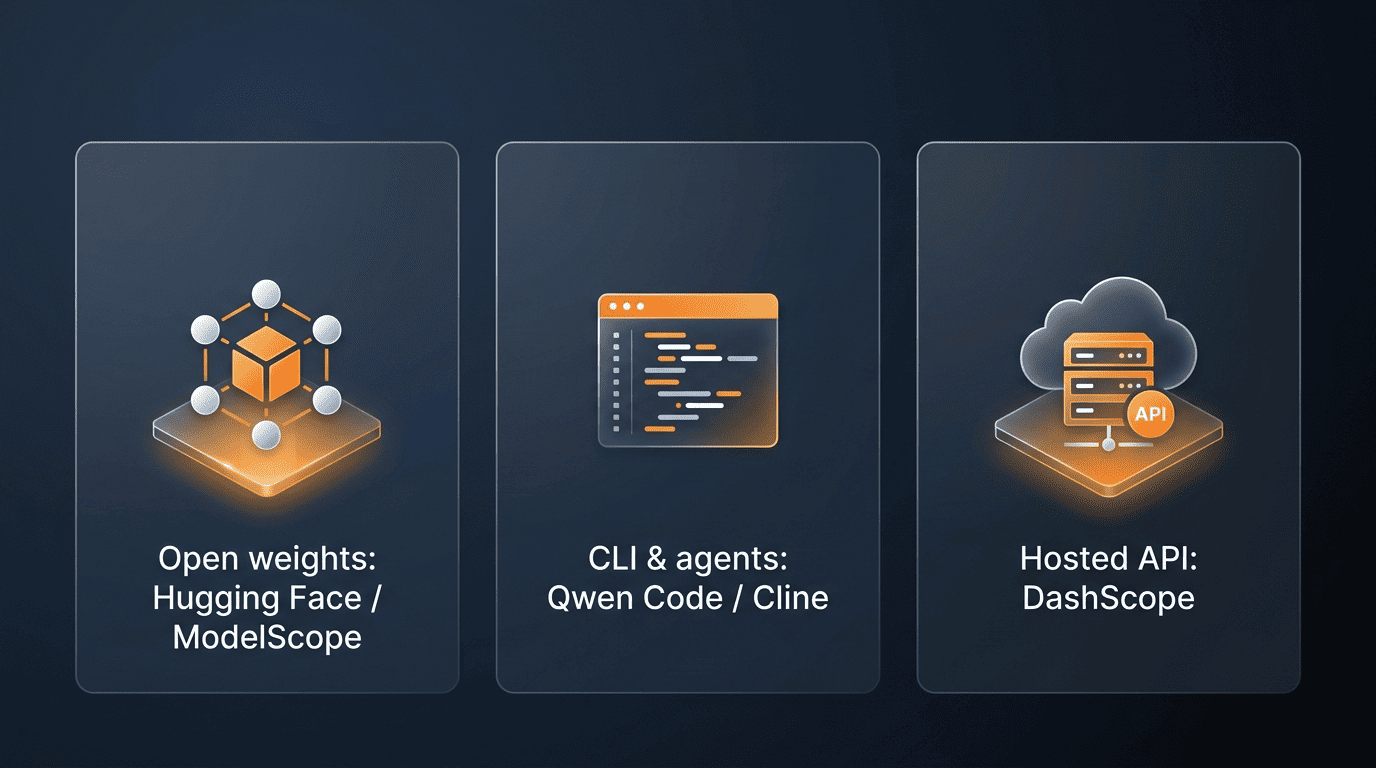
Run it locally (open weights)
Because Qwen-Coder weights are openly downloadable, you can run them entirely on your own infrastructure. A typical local setup looks like this:
- Download the model weights from Hugging Face (huggingface.co/Qwen) or ModelScope
- Choose a serving engine — vLLM and SGLang are both commonly used for Qwen-Coder inference
- Pick a quantization format if you need to fit the model into less VRAM, such as GGUF or FP8 variants where available
- Load the model into your chosen inference server
- Send completion or fill-in-the-middle (FIM) requests for autocompletion-style use cases
- For agentic tasks, wire the model into a tool-calling framework rather than using it as a plain chat endpoint
CLI and agents
Qwen Code is a command-line tool built specifically to drive Qwen-Coder models — it’s a fork of Gemini CLI, adapted by the Qwen team for their own models. Install it with:
npm i -g @qwen-code/qwen-codeQwen-Coder also integrates with existing agentic coding tools such as Cline and Claude Code, typically by pointing them at an OpenAI-compatible endpoint that serves Qwen-Coder, rather than requiring a dedicated Qwen-only client.
Hosted API (DashScope / Model Studio)
If running your own infrastructure isn’t worth it, Alibaba Cloud serves Qwen-Coder through DashScope and Model Studio, its hosted GenAI platform. Hosted models such as qwen3-coder-plus and qwen3-coder-next are reachable through both an OpenAI-compatible Chat Completions endpoint and Alibaba’s own DashScope SDK, authenticated with a DASHSCOPE_API_KEY, according to the official Qwen3-Coder blog and Alibaba Cloud’s Model Studio documentation.
Where to Get Qwen-Coder
Qwen-Coder is distributed through a handful of official channels, each suited to a different use case.
| Channel | What you’ll find there |
|---|---|
| Hugging Face (huggingface.co/Qwen) | Model weights for every Qwen-Coder size, ready to download |
| ModelScope (modelscope.cn) | Alibaba’s own model hub, mirroring the same weights |
| GitHub (github.com/QwenLM) | Source code, quickstart guides, and release documentation |
| DashScope / Model Studio | Hosted API access, no local infrastructure required |
For most developers experimenting with qwen alibaba coding models, Hugging Face is the fastest starting point for downloading weights, while DashScope is the quicker path if you’d rather skip local deployment entirely.