
Qwen by Alibaba: The Open-Weight Model Family and Alibaba Cloud’s AI Ecosystem
Qwen (Tongyi Qianwen, 通义千问) is Alibaba Cloud’s family of large language models, released largely as open-weight models. You can run Qwen by Alibaba yourself by downloading the weights, or consume it as a managed service through Alibaba Cloud. This page is a reference to the whole Alibaba Qwen models lineup and the ecosystem around it — not a chat tutorial.
Unofficial. This site is not affiliated with, endorsed by, or sponsored by Alibaba or the Qwen team.
What is Qwen by Alibaba?
Qwen is developed by Alibaba Cloud, the cloud computing arm of Alibaba Group, and it started life under a different name. The product first appeared in beta in April 2023 as Tongyi Qianwen, then went public in China after regulatory clearance. “Tongyi Qianwen” remained the Chinese brand name, while “Qwen” became the short, international name used for the open-weight releases, code repositories, and model cards.
That naming split matters because it explains why the same model family shows up under two labels depending on where you encounter it — a Chinese-market announcement versus a GitHub repo or a Hugging Face model card.
Qwen vs Tongyi Qianwen — same thing, two names
Tongyi Qianwen (通义千问) is the original Chinese product brand Alibaba used when the model first launched. Qwen is the shortened, international name attached to the open-weight models, their repositories, and their documentation. They refer to one underlying entity, not two competing products.
Wikipedia describes Qwen as “a family of large language models (LLM) developed by Alibaba Cloud.” Wikipedia — Qwen
The Qwen model family
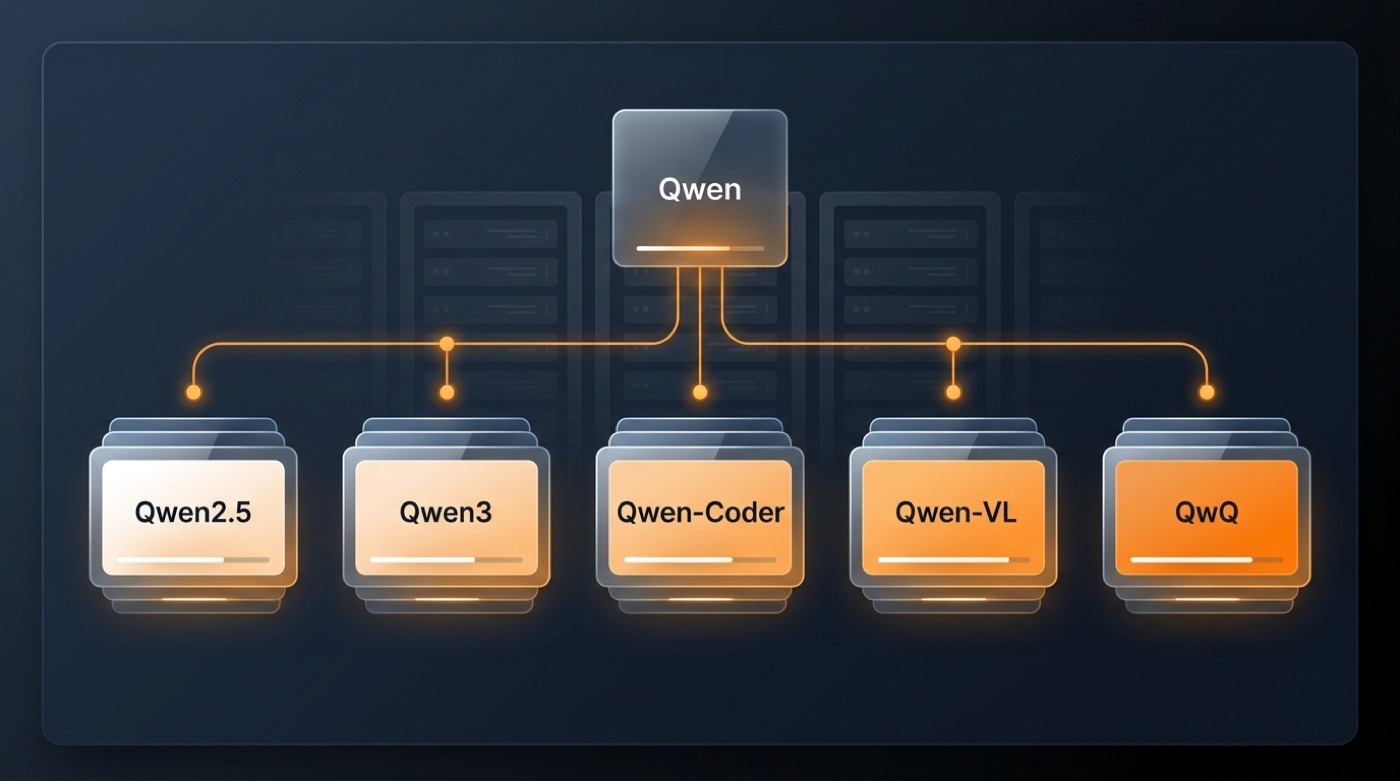
The Alibaba Qwen models span several generations plus a set of specialized lines built for specific tasks. Alibaba Cloud has iterated the mainline models multiple times since the first release, broadening the range of sizes and capabilities with each generation, while spinning off dedicated model lines for code, vision, audio, and math.
Generations (the mainline)
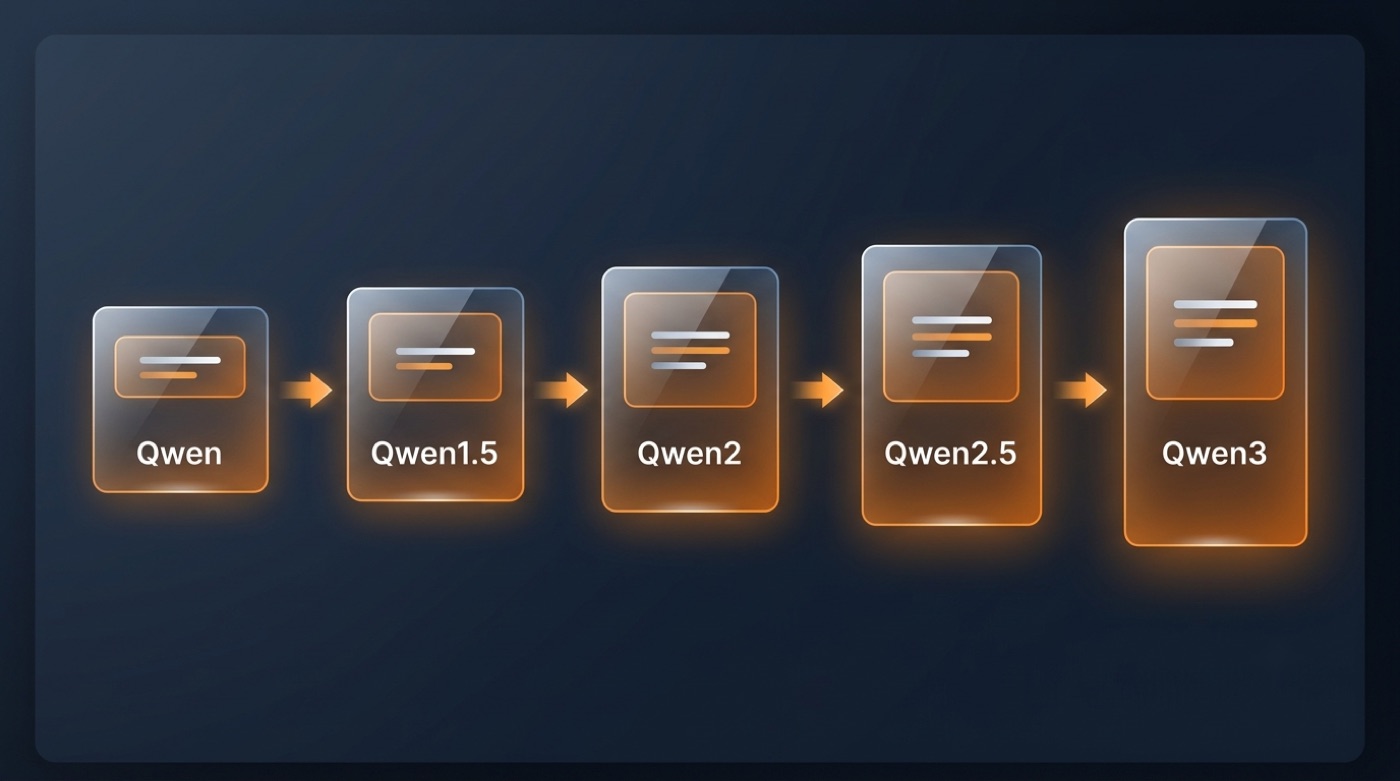
The confirmed mainline generations, in order:
- Qwen (1.0) — the original 2023 release, launched as Tongyi Qianwen.
- Qwen1.5 — an interim generation that refined the initial lineup.
- Qwen2 — released in 2024, broadening model sizes and capability.
- Qwen2.5 — a further 2024 generation with expanded variants.
- Qwen3 — the 2025 generation, the newest mainline family at time of writing.
Each generation has broadened the range of available sizes and capabilities according to Alibaba, without Alibaba publishing every exact benchmark figure as a permanent claim — treat specific scores as a moving target and check the current model card.
Specialized lines
Beyond the numbered generations, Alibaba maintains specialized lines tuned for particular jobs:
| Line | Focus | What it’s for |
|---|---|---|
| Qwen (general) | General-purpose chat and reasoning | Everyday text tasks, general assistants |
| Qwen-Coder / Qwen2.5-Coder | Code generation | Writing, completing, and explaining code |
| Qwen-VL / Qwen2-VL / Qwen2.5-VL | Vision-language | Understanding images alongside text |
| Qwen-Audio | Audio understanding | Processing and reasoning over audio input |
| Qwen-Math | Mathematical reasoning | Step-by-step math problem solving |
| QwQ | Reasoning | Extended chain-of-thought style reasoning tasks |
According to Alibaba and the QwenLM team, the family spans a wide range of sizes — from roughly half a billion parameters up to large dense models in the tens of billions of parameters — plus mixture-of-experts (MoE) variants that activate only part of the network per query.
Open source and licensing
Qwen is released as an open-weight model family, which means the trained weights are published for anyone to download and run. That is a different guarantee than “open source” in the strict software sense, and the two terms get conflated often enough that it is worth spelling out.
Is Qwen open source?
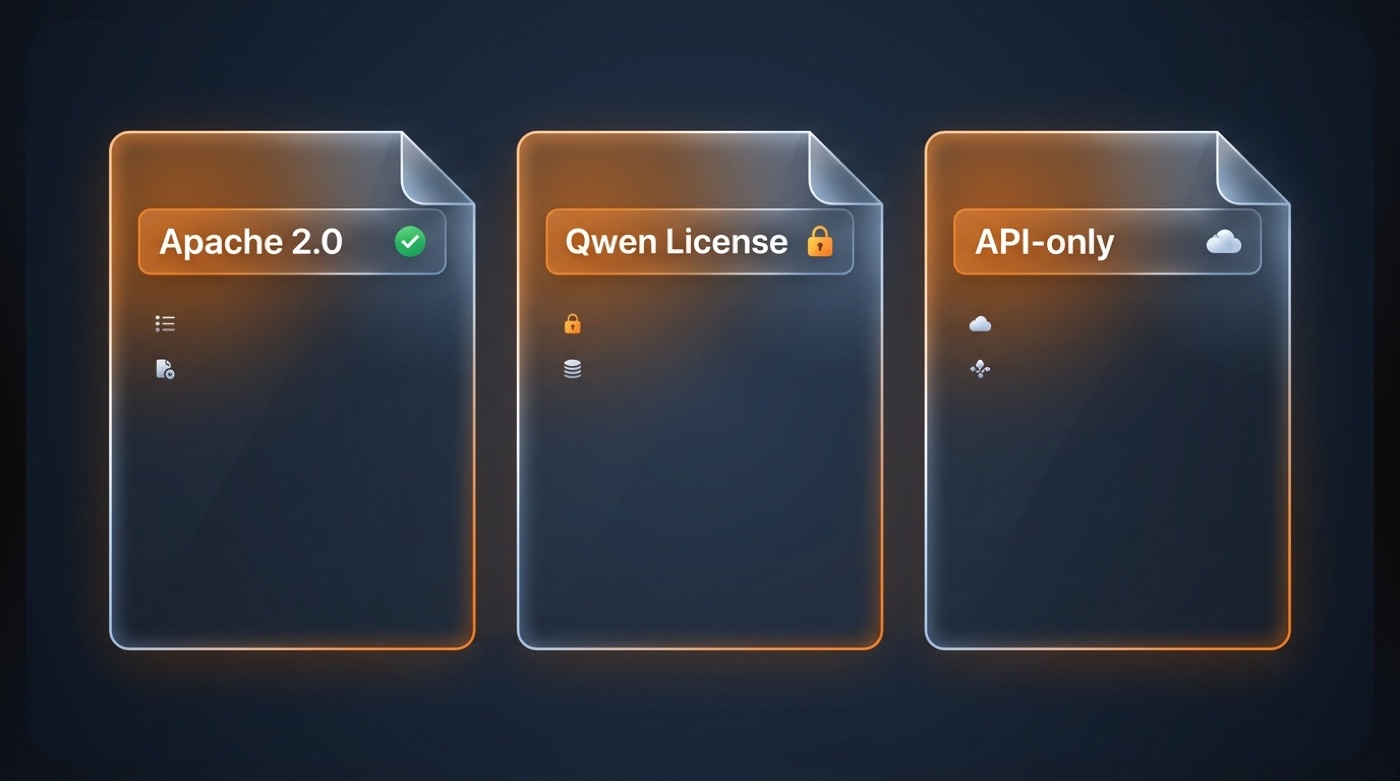
Open-weight means you can download the model weights and run them yourself — it does not automatically mean the training data, training code, or every variant is public. Many Qwen models are released under the Apache 2.0 license, a permissive license that allows commercial use, while some larger or earlier models carry a Qwen-specific license with its own terms. Always check the LICENSE file on the specific model card before deploying commercially, since licensing is set per model, not once for the whole family.
| License | Applies to | Commercial use |
|---|---|---|
| Apache 2.0 | Many current Qwen models | Yes, broadly permitted |
| Qwen-specific license | Some larger or earlier models | Depends on the specific terms |
| API-only access | Models served exclusively via DashScope | Governed by Alibaba Cloud’s service terms, not a weights license |
What “open-weight” does and does not mean:
- Does mean: you can download the published weights and run inference locally or on your own infrastructure.
- Does mean: many variants permit commercial use under Apache 2.0.
- Does not mean: the full training dataset is published.
- Does not mean: every model in the family carries the same license — check each model card individually.
- Does not mean: the largest or newest models are automatically open-weight; some are served only through the managed API.
Where to get Qwen — the model hubs
Alibaba and the QwenLM team publish weights, code, and release notes across a handful of official channels rather than a single portal.
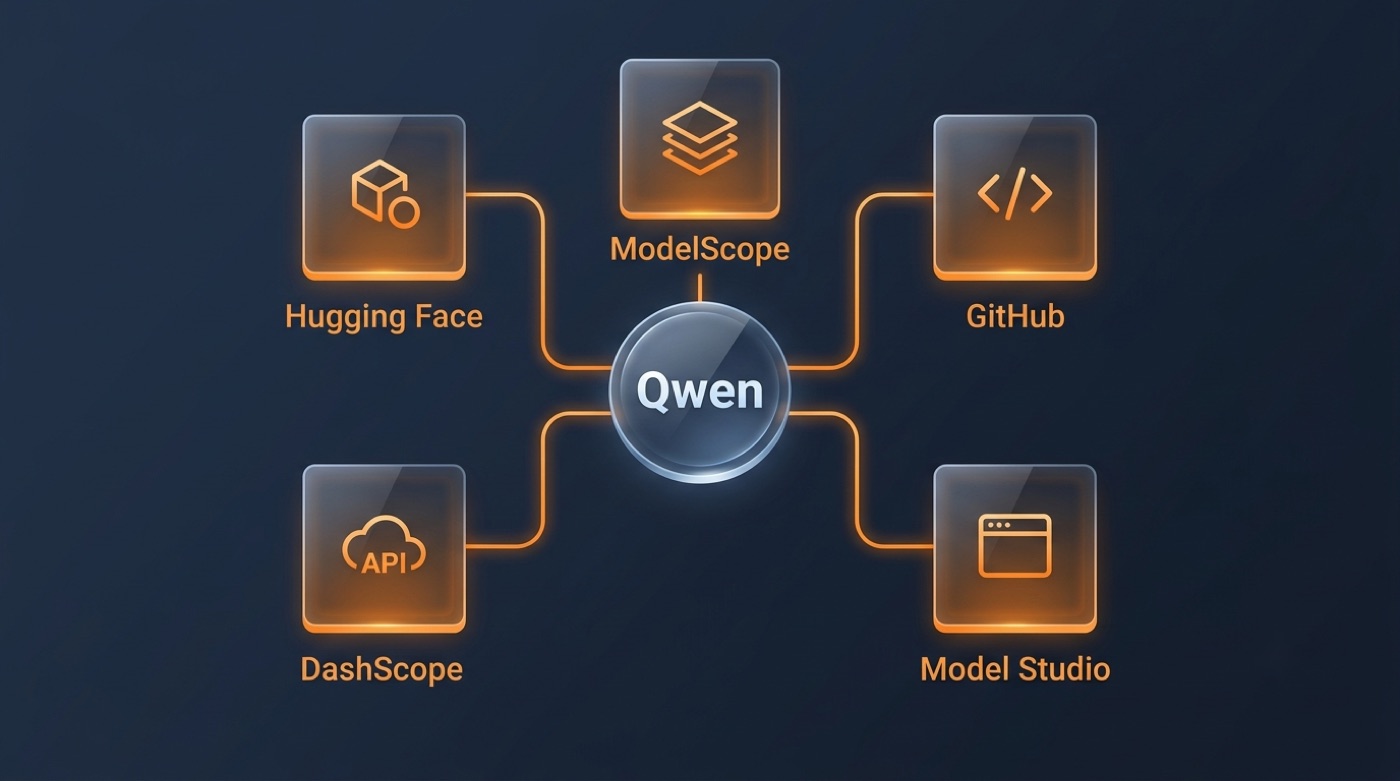
Official channels
- Hugging Face — the primary hub where open Qwen weights are published for download.
- ModelScope — Alibaba’s own model hub, effectively its answer to Hugging Face, hosting the same and additional Qwen releases.
- GitHub (QwenLM) — source code, inference scripts, and repository-level documentation.
- Qwen blog — release notes and announcements from the team behind each new generation.
Weights for Alibaba Qwen models are published on both Hugging Face and ModelScope simultaneously in most cases, so the choice of hub is mostly a matter of preference or regional access.
The Alibaba Cloud AI ecosystem
Beyond the open weights, Alibaba Cloud runs a managed ecosystem around Qwen for teams that would rather not host models themselves. DashScope is Alibaba Cloud’s model-serving API and platform for Qwen, and Model Studio (also known as Bailian) sits a layer above it as the application platform for building assistants, retrieval-augmented generation (RAG) pipelines, and agents on top of the served models.
DashScope and Model Studio
DashScope handles the serving layer: it exposes Qwen models through an API so developers can call them without provisioning GPUs or managing inference infrastructure. Model Studio builds on that serving layer, giving teams a higher-level platform to assemble assistants, agents, and RAG applications without writing the orchestration from scratch.
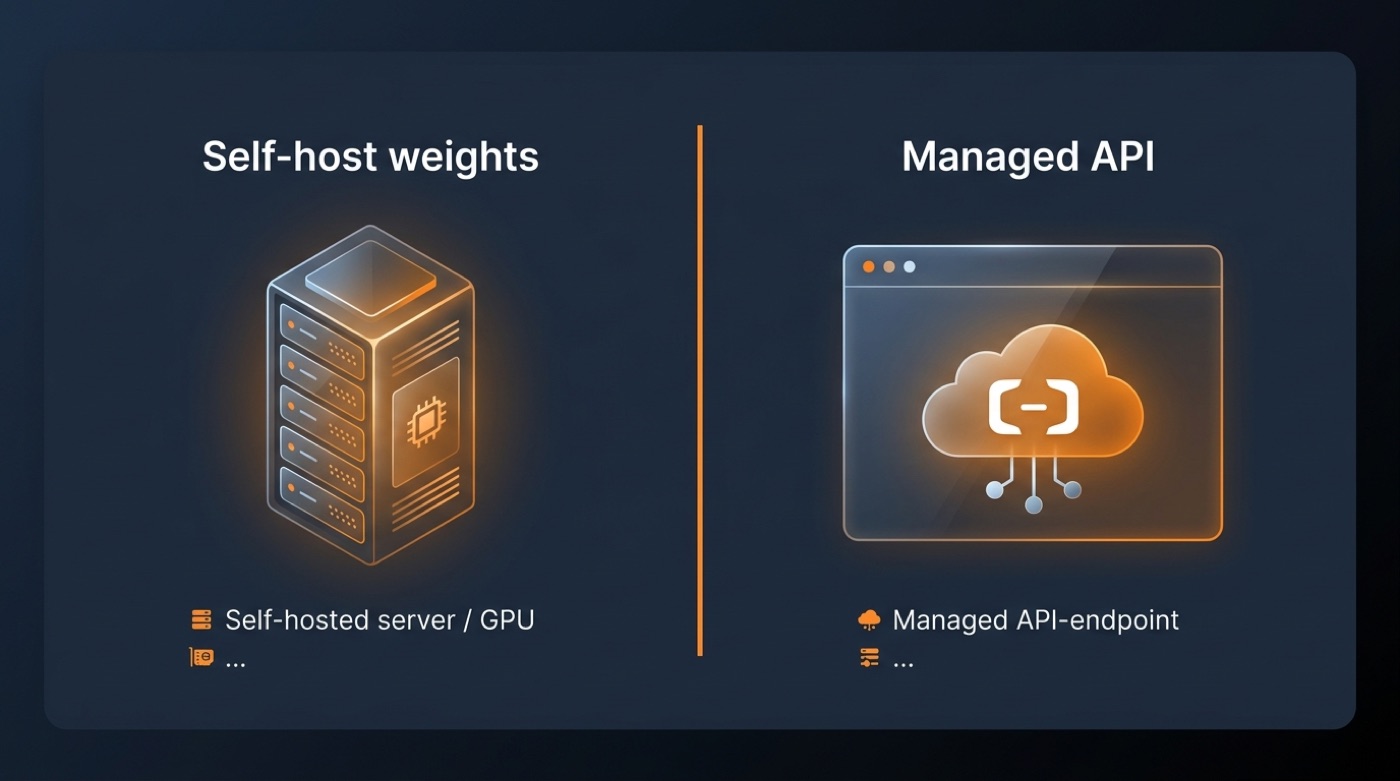
Two ways to run Qwen:
- Self-host the open weights — download from Hugging Face or ModelScope, run on your own infrastructure. You get full control over data, customization, and cost of your own compute, with the tradeoff of managing that infrastructure yourself.
- Use Alibaba Cloud’s managed API — call Qwen through DashScope, optionally building on Model Studio. No infrastructure to manage, pay-per-use pricing, but you depend on Alibaba Cloud’s availability and terms.
Alibaba Cloud documents the managed side of this ecosystem on its generative AI solutions pages, which is the authoritative source for current product tiers rather than any third-party summary.
Qwen Chat and the consumer surface
The same underlying model family also powers Qwen Chat, the consumer-facing web app at qwen.ai. That is a separate surface from what this page covers: here the focus stays on the model family and the developer/enterprise ecosystem around it — the weights, the licensing, and DashScope/Model Studio — rather than the end-user chat interface.
Adoption: developers, fine-tunes and the open-weight scene
Because so much of the family ships as open weights, Qwen models are widely used as base models for community fine-tunes, and they frequently appear near the top of open-weight leaderboards according to reports from Alibaba and the broader open-weight community. The most commonly cited point of comparison is DeepSeek, another prominent Chinese lab releasing open-weight models.
Qwen vs DeepSeek (at a glance)
Both are prominent Chinese open-weight LLM families, but they come from different organizations and take different approaches. Qwen is developed by Alibaba Cloud and spans a broad, multi-line family covering code, vision-language, audio, and reasoning variants. DeepSeek is built by a separate lab and is particularly known for its reasoning-focused and mixture-of-experts architectures. Neither is a categorical “winner” — they represent two of the strongest open-weight options, and the right choice depends on the specific task, license terms, and deployment constraints of a given project.
Qwen vs the closed frontier models
The other axis of comparison is Qwen against the closed, proprietary frontier flagships — chiefly OpenAI’s GPT-5.6 Sol and Anthropic’s Claude Fable 5. Those are served only as hosted APIs with no downloadable weights, whereas Qwen’s defining trait is that most of the family ships as open weights you can self-host and fine-tune. The trade-off is the familiar one: the proprietary flagships set the reference bar for the hardest frontier tasks, while open-weight Qwen offers control, data residency, and cost predictability through self-hosting. Which matters more depends on the workload, and many teams run both — reserving a closed flagship for the hardest jobs and a self-hosted Qwen model for everything else. Capability gaps between open and closed models shift with every release, so treat any fixed comparison as provisional.
Explore the Qwen family
Dig deeper into our fact-checked, unofficial Qwen reference:
- Qwen models — the full family: sizes, generations and specialized lines
- Qwen3 — the latest generation and how to access it
- Qwen2.5 — the widely adopted generation and its open weights
- Qwen-Coder — Alibaba’s open coding models
- Qwen-VL — the vision-language models
- Tongyi Qianwen — the origin and brand behind Qwen
- Qwen open source — open-weight releases and licensing
- DashScope — Alibaba Cloud’s Qwen API and Model Studio
- ModelScope — Alibaba’s open model hub
- Qwen vs DeepSeek — two open-weight families compared
Frequently Asked Questions
- What is Qwen and who makes it?
Qwen (通义千问, Tongyi Qianwen) is a family of large language models developed by Alibaba Cloud, part of Alibaba Group. The first Qwen models were released in 2023, and the line has grown into a broad family of open-weight models spanning many sizes and specializations.
- Is this the official Alibaba or Qwen site?
No. qwenalibaba.pro is an independent, unofficial reference site with a free Qwen assistant. It is not affiliated with, endorsed by, or operated by Alibaba or the Qwen team. Official resources include qwenlm.github.io, github.com/QwenLM and huggingface.co/Qwen.
- Which Qwen models are open-weight?
Alibaba has released many Qwen models with open weights, a large number of them under the permissive Apache 2.0 license. Confirmed lines include Qwen2.5 and Qwen3, plus specialized models such as Qwen-Coder (code), Qwen-VL (vision-language), Qwen-Audio, Qwen-Math and the QwQ reasoning model. Licensing varies by model — always check the model card.
- Where can I download Qwen models?
Open-weight Qwen models are published on Hugging Face (huggingface.co/Qwen) and Alibaba’s own ModelScope hub (modelscope.cn). You can run them locally/self-hosted, or call hosted Qwen models through Alibaba Cloud’s DashScope API and Model Studio.
- What is the difference between Qwen, Tongyi Qianwen and DashScope?
Tongyi Qianwen is the original Chinese brand name for the models; Qwen is the international name used for the open-weight releases. DashScope is Alibaba Cloud’s API/platform for serving Qwen models, and Model Studio is the broader GenAI platform around it.
- How does Qwen compare to other open models?
Qwen is one of the most widely adopted open-weight families and is frequently used as a base for community fine-tunes. It is known for broad multilingual coverage, a wide range of model sizes, and specialized Coder and VL lines. We keep a fact-checked, qualitative comparison with DeepSeek — see the guides below.