
Qwen Models Explained: Alibaba’s Open-Weight AI Family (Full Guide)
Qwen is the family of large language models qwen by alibaba — also called Tongyi Qianwen — built by Alibaba Cloud and released largely as open weights, according to the project’s own Hugging Face organization page. The family spans general-purpose LLMs plus specialized lines for coding, vision, audio, math and reasoning, in sizes from a few hundred million to hundreds of billions of parameters.
This guide maps every major branch — generations (Qwen2.5, Qwen3), specialized models (Qwen-Coder, Qwen-VL, Qwen-Audio, Qwen-Math, QwQ), open weights vs commercial API tiers, and exactly where to download or call each one.
Unofficial. This site is not affiliated with, endorsed by, or sponsored by Alibaba or the Qwen team.
What are the Qwen models?
Qwen = Tongyi Qianwen, by Alibaba Cloud
Qwen (Chinese: 通义千问, Tongyi Qianwen) is Alibaba Cloud’s family of large language models, first released in 2023. “Qwen” is the international brand name; “Tongyi Qianwen” is the Chinese name for the same underlying project, as described on Wikipedia. The family powers Alibaba’s own Qwen Chat assistant, but the model family itself — the weights, the architectures, the specialized variants — is the actual product that developers and enterprises build on.
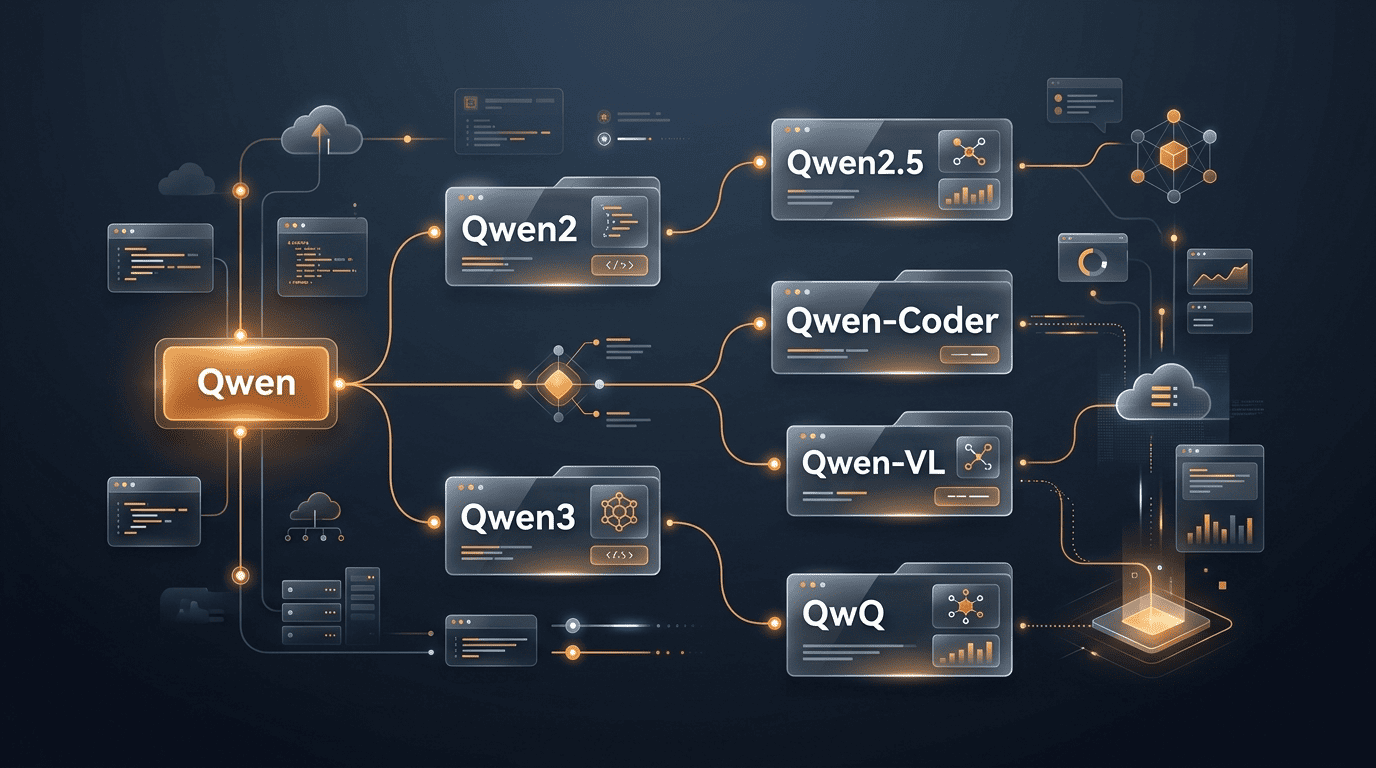
One family, many branches
The Qwen line splits into two shapes. First, the numbered generations — general-purpose text models that improve release over release. Second, a set of specialized branches built on top of those generations: code, vision-language, audio, math, and step-by-step reasoning. Sizes range from small dense models under 1 billion parameters, small enough to run on a laptop, up to very large Mixture-of-Experts (MoE) models with hundreds of billions of total parameters aimed at servers. Alibaba states that recent Qwen versions support a large number of languages — figures like 100+ or 119 languages appear in Alibaba’s own materials, though exact counts vary by model and should be checked per release rather than assumed.
The Qwen generations: a timeline
From Qwen 1.0 to Qwen3
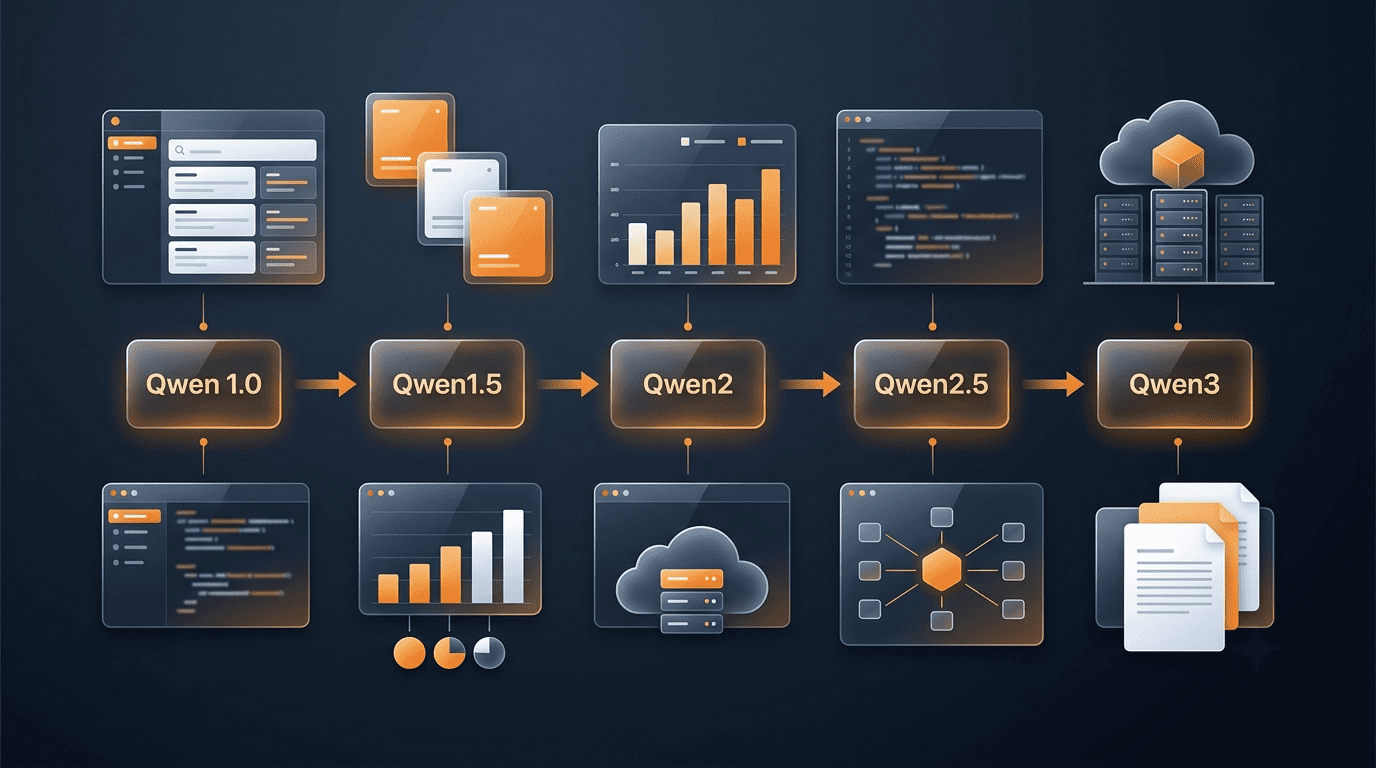
The confirmed generation line runs from Qwen 1.0 through Qwen1.5, Qwen2 and Qwen2.5, up to Qwen3. Qwen 1.0 launched in 2023 with sizes including 1.8B, 7B, 14B and 72B parameters. Qwen1.5 and Qwen2 followed as incremental generations through 2024, each widening the size lineup and improving quality. Qwen2.5 became the generation most widely adopted by the open-source community, forming the base for many downstream fine-tunes and specialized variants. Qwen3 is the latest flagship generation, released April 28, 2025. According to the official QwenLM release blog:
Today, we are excited to announce the release of Qwen3, the latest addition to the Qwen family of large language models.
QwenLM official blog
Qwen3 is notable for combining dense and Mixture-of-Experts models in the same generation, with several of those models open-weighted under the Apache 2.0 license. Exact parameter counts and benchmark scores shift release to release, so treat any specific number as something to verify against the model card at the time you’re evaluating it, not as a fixed fact.
Qwen generations at a glance
| Generation | Released | Notable trait | Example sizes |
|---|---|---|---|
| Qwen (1.0) | 2023 | First public release | 1.8B / 7B / 14B / 72B |
| Qwen1.5 | 2024 | Incremental generation | Multiple sizes |
| Qwen2 | 2024 | Broader lineup | Multiple sizes |
| Qwen2.5 | 2024 | Most widely adopted generation | Multiple sizes |
| Qwen3 | April 2025 | Dense + MoE, Apache 2.0 | Small to very large (incl. MoE) |
Specialized Qwen model lines
Beyond the numbered generations, Alibaba maintains several specialized branches, each built for a narrower job rather than general chat. The code, code repositories and documentation for these live at github.com/QwenLM.
Qwen-Coder — open coding models
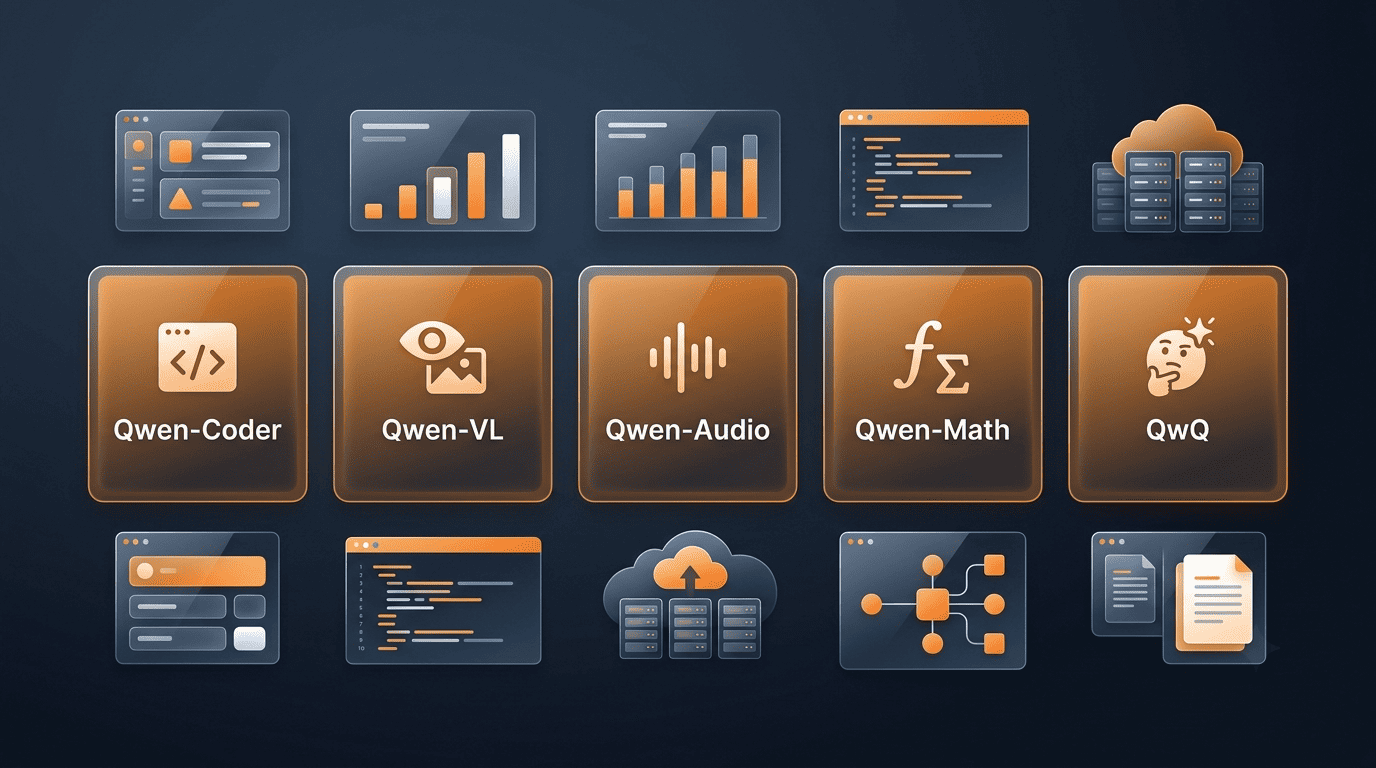
Qwen-Coder (and Qwen2.5-Coder) is purpose-built for code generation and completion. It’s released in multiple sizes, which makes it a practical open-weight option for teams that want a self-hosted or on-device coding assistant rather than routing every completion through a third-party API. For a developer evaluating local tooling, this is usually the first line to test before reaching for a general-purpose model.
Qwen-VL — vision-language
Qwen-VL is the multimodal branch — models that read images alongside text. The line has iterated through Qwen-VL, Qwen2-VL and Qwen2.5-VL. Typical use cases include optical character recognition, document understanding, and answering questions about the contents of an image, which makes it relevant for document-processing pipelines as much as for general visual Q&A.
Qwen-Audio, Qwen-Math, QwQ
Qwen-Audio handles audio understanding tasks. Qwen-Math is tuned for mathematical reasoning. QwQ is a separate reasoning-focused line, designed to work through problems step by step rather than answer in one pass; QwQ-32B-Preview was released in November 2024 as open weights under the Apache 2.0 license. Keep expectations qualitative here — “designed for reasoning tasks” is accurate, but exact benchmark scores change with each release and shouldn’t be treated as fixed.
Pick a line by task
- General chat or writing → a numbered generation (Qwen2.5 or Qwen3)
- Coding assistant → Qwen-Coder / Qwen2.5-Coder
- Images or document understanding → Qwen-VL
- Audio understanding → Qwen-Audio
- Math-heavy problems → Qwen-Math
- Multi-step reasoning → QwQ
Open weights vs commercial API tiers
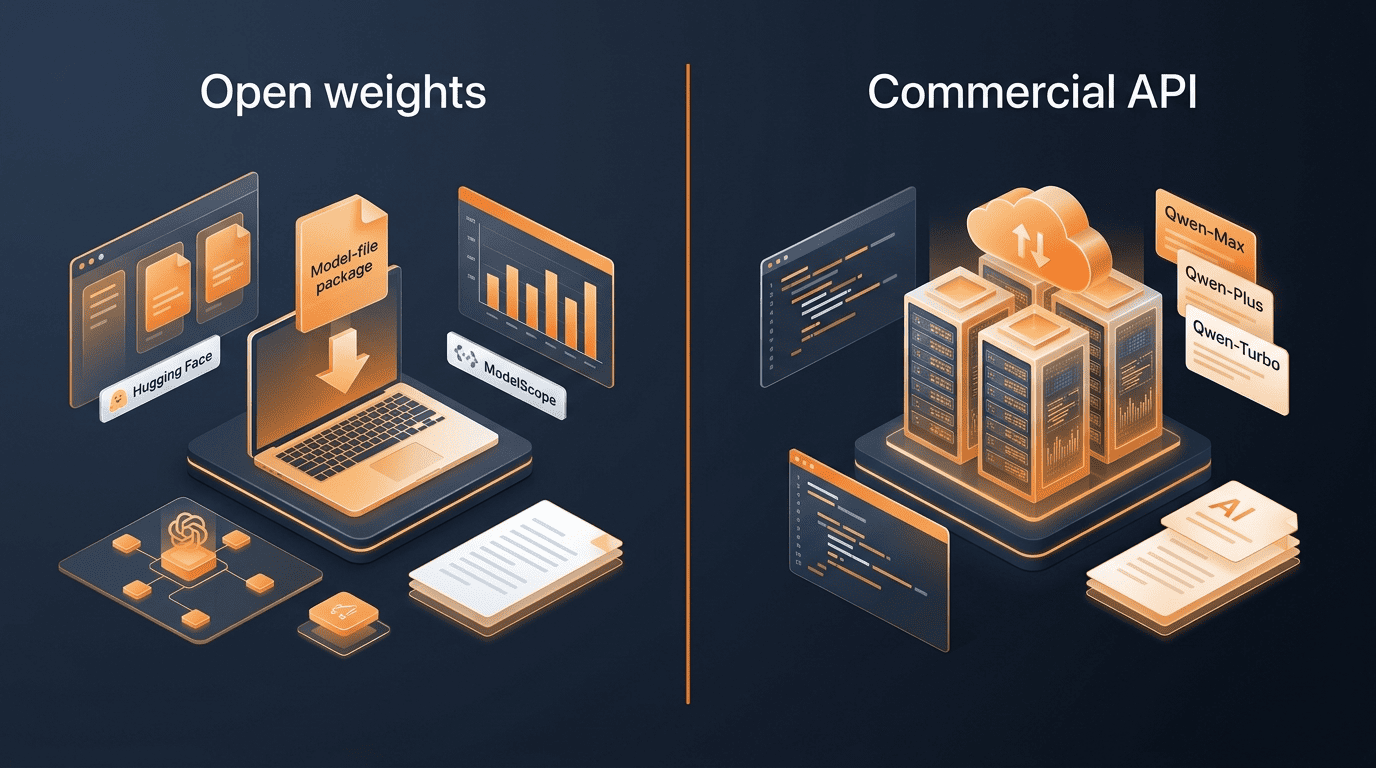
Open weights (download and run yourself)
Many Qwen models are released as open weights under the Apache 2.0 license, which in practice lets you download the files, self-host, fine-tune, and ship commercially — subject to each specific model’s license terms. That caveat matters: not every Qwen model is Apache 2.0. Some earlier or larger releases use a Qwen-specific license instead, so checking the model card before you commit to a deployment is worth the two minutes it takes.
Commercial tiers (call the API)
Alibaba Cloud also offers hosted tiers you call over an API rather than download: Qwen-Max (the flagship, highest-capability tier), Qwen-Plus (a balanced middle option), and Qwen-Turbo and Qwen-Flash, which prioritize speed and lower cost. These are served through DashScope and Alibaba Cloud Model Studio (also known as Bailian). The trade-off is straightforward: open weights give you control, data privacy, and no per-token billing, but you run the infrastructure yourself; the API gives you the latest hosted models with no infrastructure to manage, billed per token.
Open weights vs API
| Option | You get | Best for | Where |
|---|---|---|---|
| Open weights (Apache 2.0, etc.) | Full model files | Self-hosting, fine-tuning, data privacy | Hugging Face / ModelScope / Ollama |
| Commercial API (Max / Plus / Turbo / Flash) | Hosted inference | Fastest start, no infrastructure | DashScope / Model Studio |
Model sizes: dense vs Mixture-of-Experts
Why the size range matters
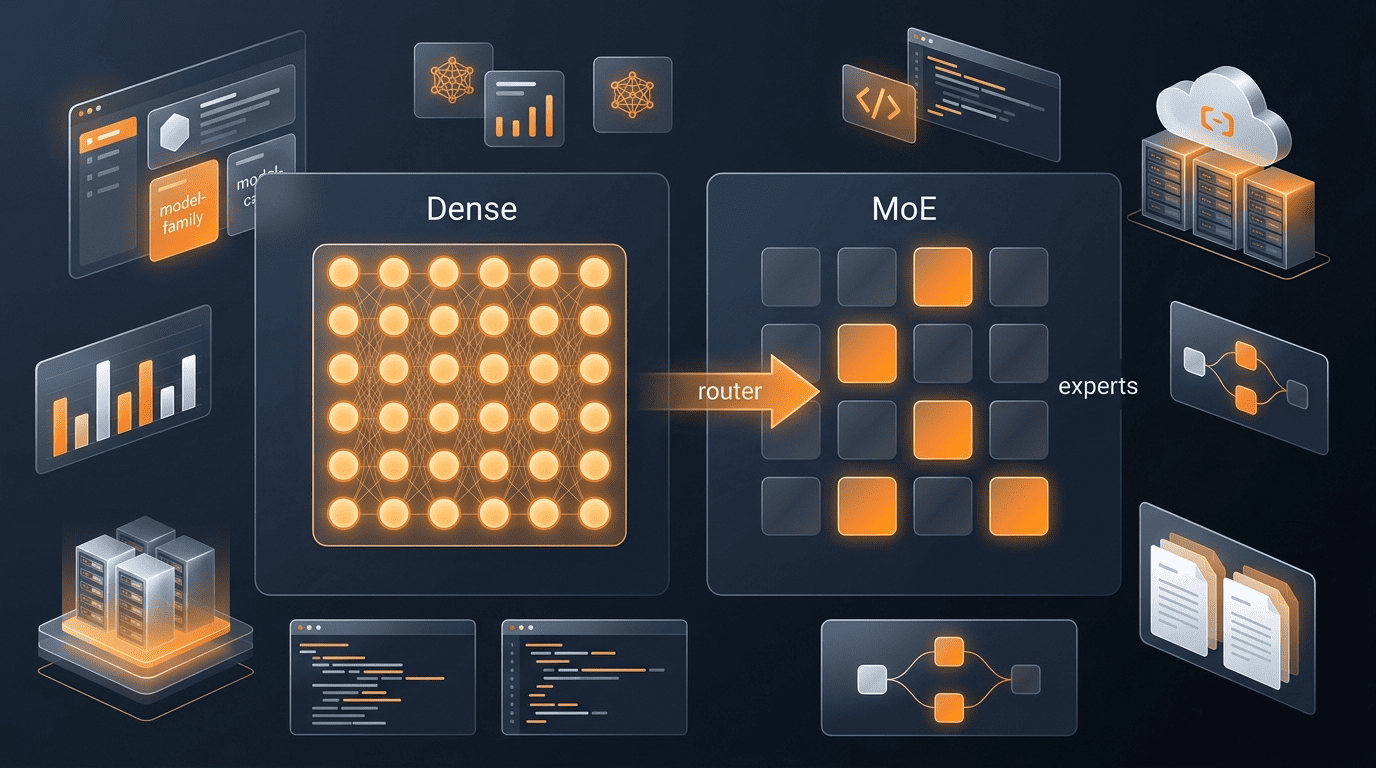
The Qwen family spans small dense models — sub-1B up to roughly 7B parameters — that run comfortably on modest hardware, including laptops without a dedicated GPU. Mid-size models in the 14B–32B range need a reasonably capable GPU to run at usable speed. Large dense models around 72B, plus MoE models, are generally aimed at servers rather than personal machines. MoE architectures let the total parameter count be very large while activating only a subset of those parameters per token, which keeps per-token compute lower than a dense model of the same total size. Treat any specific parameter figure as something to confirm against the model card for the exact release you’re using, since sizes and naming conventions have shifted across generations.
Choose a size by hardware
- Laptop / CPU or small GPU — small dense model, roughly sub-1B to ~7B
- Single modern GPU — around 7B–14B
- Workstation or multi-GPU setup — 32B–72B, or a smaller MoE model
- Server or cloud — the largest MoE models, or the hosted API tiers instead of self-hosting
Where to get Qwen models
Download channels
Four channels cover most of how developers get hold of Qwen models:
- Hugging Face (huggingface.co/Qwen) — the main open-weight hub, including quantized formats such as GGUF, AWQ and FP8 for many models
- ModelScope (modelscope.cn) — Alibaba’s own model hub, often the fastest download source for users in China
- Ollama — one-command local runs for many of the popular Qwen sizes, which lowers the barrier for anyone who wants to try a model without configuring an inference stack by hand
- GitHub (github.com/QwenLM) and the official QwenLM blog — code, documentation and release notes
API access
DashScope and Alibaba Cloud Model Studio (Bailian) serve Qwen over API, covering both the commercial tiers and hosted versions of the open models. The API follows an OpenAI-compatible style in several client libraries, which means tooling already built against OpenAI’s API format tends to port over with minimal changes.
Which Qwen model should you pick?
A quick decision guide
- Want the newest general-purpose model, self-hosted → the latest open Qwen3 size that fits your hardware
- Want a proven, widely-supported generation → Qwen2.5
- Building a coding assistant → Qwen-Coder
- Working with images or documents → Qwen-VL
- Reasoning-heavy tasks → QwQ
- No infrastructure to manage, want a managed service → Qwen-Max, Qwen-Plus or Qwen-Turbo via API
Whichever line you land on, check the specific model card for its license and context length before committing — these details vary by model and change across releases, and they’re the two things most likely to break a production deployment if assumed rather than confirmed.