
Qwen vs DeepSeek: Comparing Two Leading Chinese Open-Weight AI Families
Unofficial. This site is not affiliated with, endorsed by, or sponsored by Alibaba or the Qwen team.
Qwen and DeepSeek are the two most talked-about Chinese open-weight model families, but they come from different teams with different priorities. Qwen by Alibaba is Alibaba Cloud’s broad model ecosystem spanning language, vision, code, and audio, while DeepSeek is a smaller, reasoning-focused lab. According to the Qwen project page on Hugging Face, the family already spans dozens of model variants and sizes.
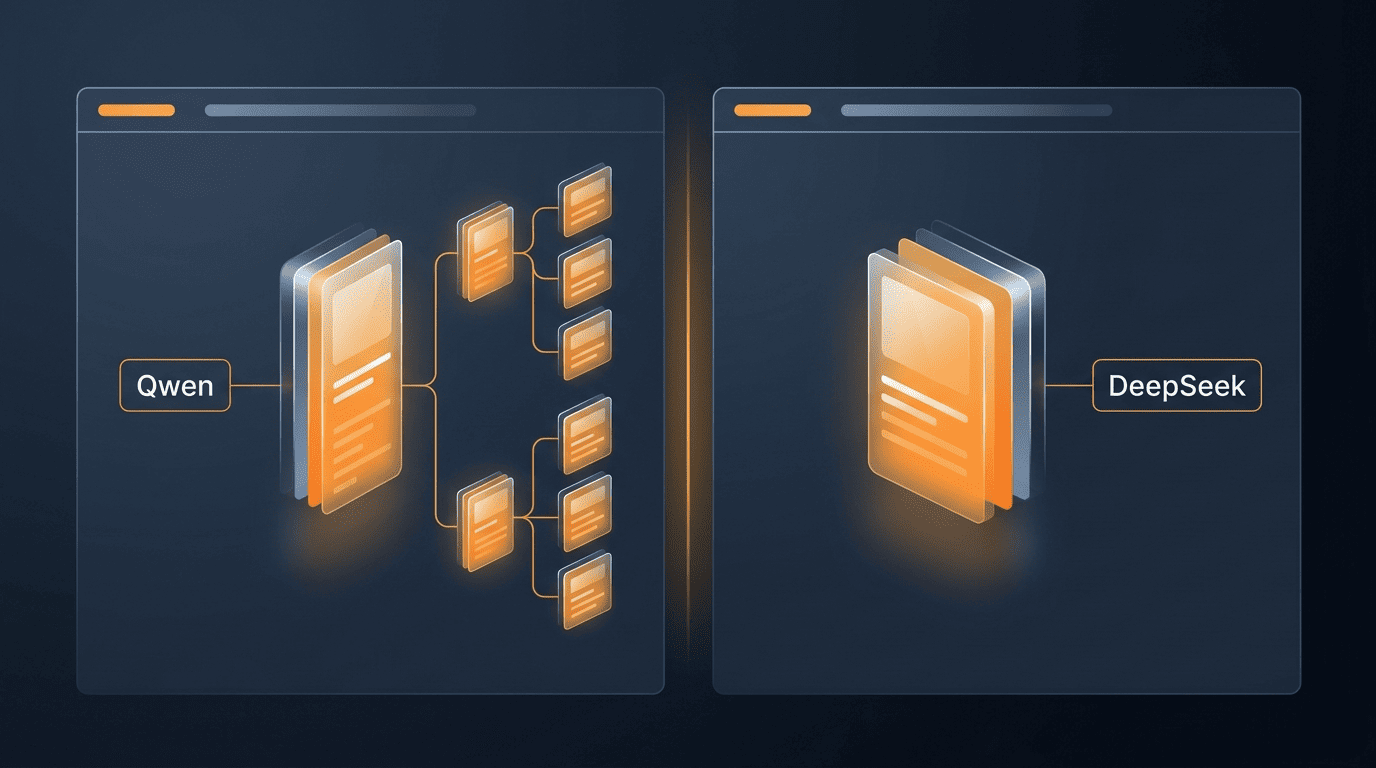
This guide compares who builds each family, how they handle open-weight licensing, what their model line-ups actually contain, where each tends to shine, and how to pick between them for a real project. Every claim below is attributed to an official source rather than a benchmark score, since public number comparisons between these two families change constantly and often contradict each other.
Who Makes Qwen and Who Makes DeepSeek
Before comparing capabilities, it helps to know who is actually building each family, since that shapes release cadence, licensing choices, and product focus. Both companies are Chinese, but they operate in very different worlds — one is a cloud division of a trillion-dollar conglomerate, the other a lab that grew out of a quantitative trading firm.
| Qwen | DeepSeek | |
|---|---|---|
| Developer | Alibaba Cloud (Alibaba Group) | DeepSeek AI |
| Backing | Part of Alibaba Group’s cloud business | Associated with quant firm High-Flyer |
| First models | 2023 | Emerged with early open-weight releases, gained wide attention with DeepSeek-V3 and DeepSeek-R1 |
| Public presence | qwenlm.github.io, Qwen Chat | huggingface.co/deepseek-ai, GitHub repos |
Qwen — Alibaba Cloud’s model family
Qwen, also known by its Chinese name Tongyi Qianwen, is developed by Alibaba Cloud, the cloud computing division of Alibaba Group. The first Qwen models appeared in 2023, and the project has since grown into a broad ecosystem rather than a single model — it now covers general-purpose language models plus specialized lines for vision, coding, audio, and math. Per Alibaba’s own project materials on qwenlm.github.io, Qwen is positioned as an open, actively maintained family rather than a one-off release.
DeepSeek — a reasoning-focused lab
DeepSeek, operating as DeepSeek AI, is an AI lab associated with the Chinese quantitative trading firm High-Flyer. It rose to prominence with efficient, reasoning-oriented open-weight models rather than trying to match Qwen’s breadth. Where Qwen ships many specialized lines, DeepSeek has stayed narrower, concentrating engineering effort on a small number of flagship releases that push hard on reasoning and coding performance.
Open-Weight Strategy and Licensing
Both Qwen and DeepSeek publish open weights, which is a large part of why they get compared so often — teams can download, self-host, and fine-tune either family instead of relying on a closed API. But “open-weight” is not one uniform thing, and the licensing details differ enough to matter for commercial use.
Both families release downloadable weights on Hugging Face, and Qwen additionally publishes on Alibaba’s own ModelScope platform. Open-weight availability means the trained parameters are downloadable and runnable locally; it does not necessarily mean the full training data or training pipeline is disclosed, and that distinction is worth keeping in mind when evaluating either family for compliance-sensitive use.
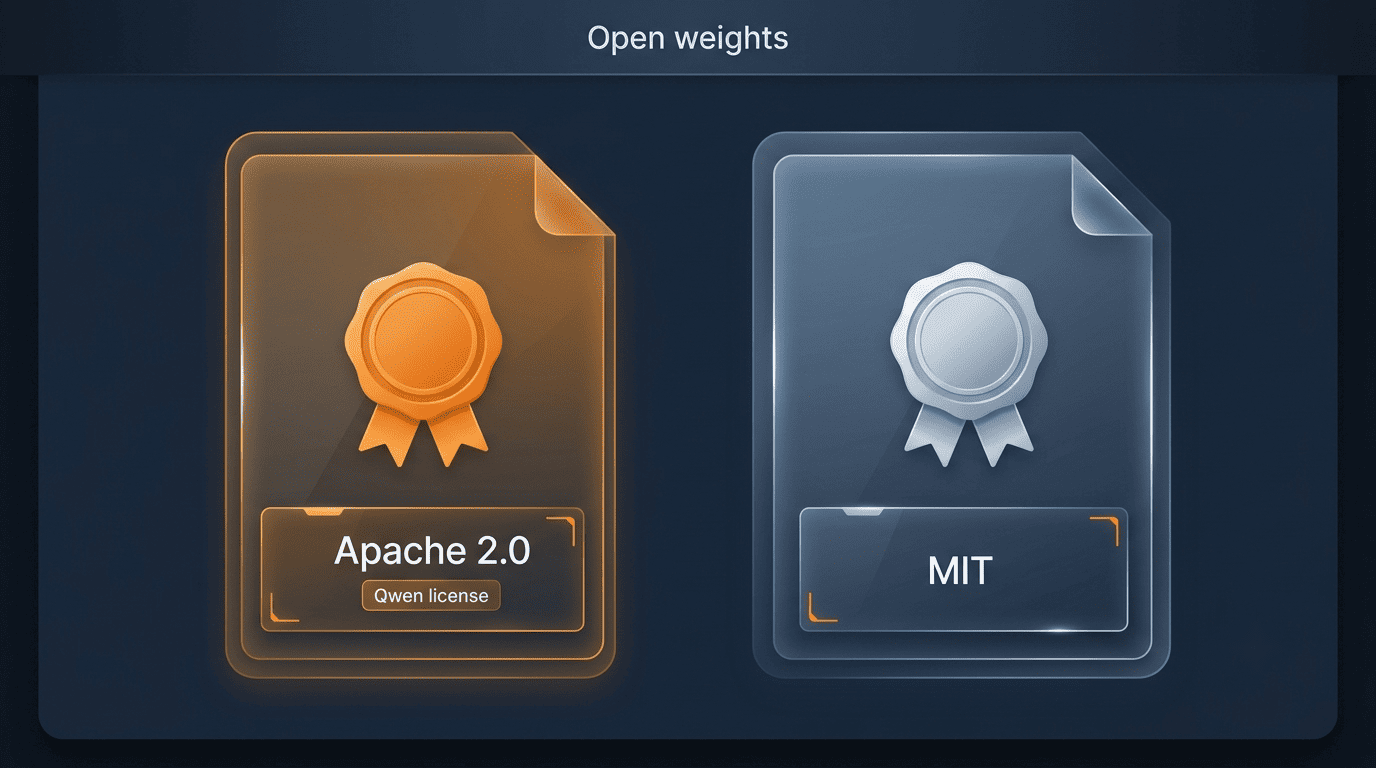
All our open-source models, except for the 3B and 72B variants, are licensed under Apache 2.0.
Qwen Team, QwenLM blog — Qwen2.5 release post
Licensing differs in the details
Many Qwen models are released under the Apache 2.0 license, one of the most permissive open-source licenses available, though some specific models are distributed under a Qwen-specific or Tongyi Qianwen license with its own terms — the exact license should always be checked per model card on Hugging Face rather than assumed. DeepSeek, by contrast, has released its flagship model weights under the MIT license, another highly permissive option, as documented in its repositories on huggingface.co/deepseek-ai. Neither family’s licensing choice makes one meaningfully “more open” than the other in practice — both allow broad commercial use, but always verify the license attached to the specific model version you plan to deploy.
Model Line-Ups Side by Side
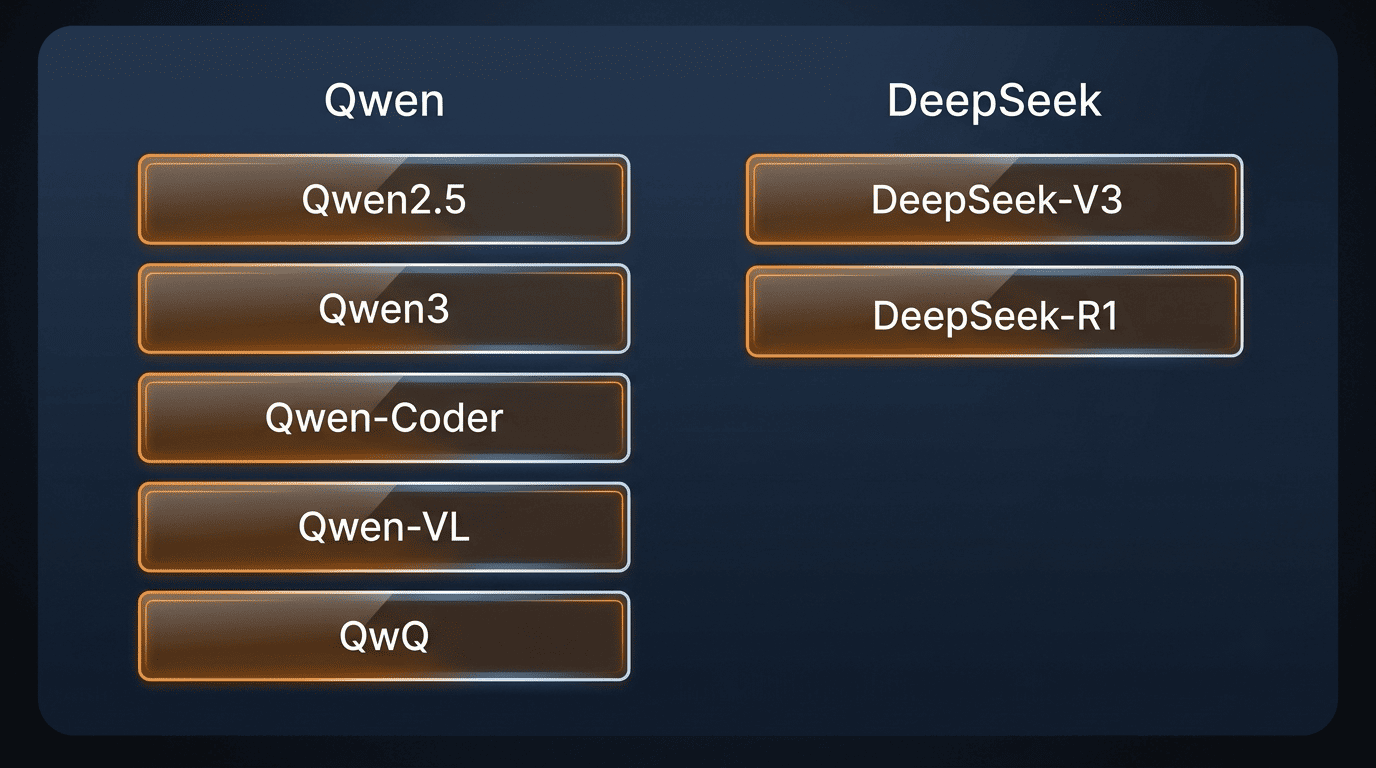
The clearest structural difference between Qwen and DeepSeek shows up in how many distinct model lines each one maintains. Qwen has grown into a wide portfolio; DeepSeek has stayed deliberately narrow.
The Qwen family is broad
Qwen’s confirmed generations include the original Qwen (1.0), Qwen1.5, Qwen2, Qwen2.5, and Qwen3, released progressively since 2023. Alongside the general-purpose line, Alibaba maintains several specialized branches: Qwen-Coder (and Qwen2.5-Coder) for code generation, Qwen-VL (with Qwen2-VL and Qwen2.5-VL) for vision-language tasks, Qwen-Audio for audio understanding, Qwen-Math for mathematical reasoning, and QwQ as a dedicated reasoning-oriented model. These come in many sizes, from compact models suitable for local hardware to large ones, and use both dense and Mixture-of-Experts (MoE) architectures depending on the release.
DeepSeek is a tighter, reasoning-centric line
DeepSeek’s confirmed flagship releases are DeepSeek-V3, a large general-purpose model built on a Mixture-of-Experts architecture, and DeepSeek-R1, a model purpose-built for step-by-step reasoning. DeepSeek has also historically released coding-oriented models under the DeepSeek-Coder name. Compared to Qwen’s sprawling portfolio, DeepSeek’s line-up favors depth over breadth — fewer models, each aimed squarely at reasoning, math, and code rather than covering vision or audio.
| Family | Confirmed lines | Architecture note |
|---|---|---|
| Qwen | Qwen 1.0 → Qwen3, Qwen-VL, Qwen-Coder, Qwen-Audio, Qwen-Math, QwQ | Mix of dense and MoE models across sizes |
| DeepSeek | DeepSeek-V3, DeepSeek-R1, historically DeepSeek-Coder | DeepSeek-V3 uses Mixture-of-Experts |
Strengths: Where Each Tends to Shine
Neither family is strictly “better” — they’re built for different balances of breadth versus specialization. Understanding what each optimizes for makes it much easier to shortlist the right one for a given project.
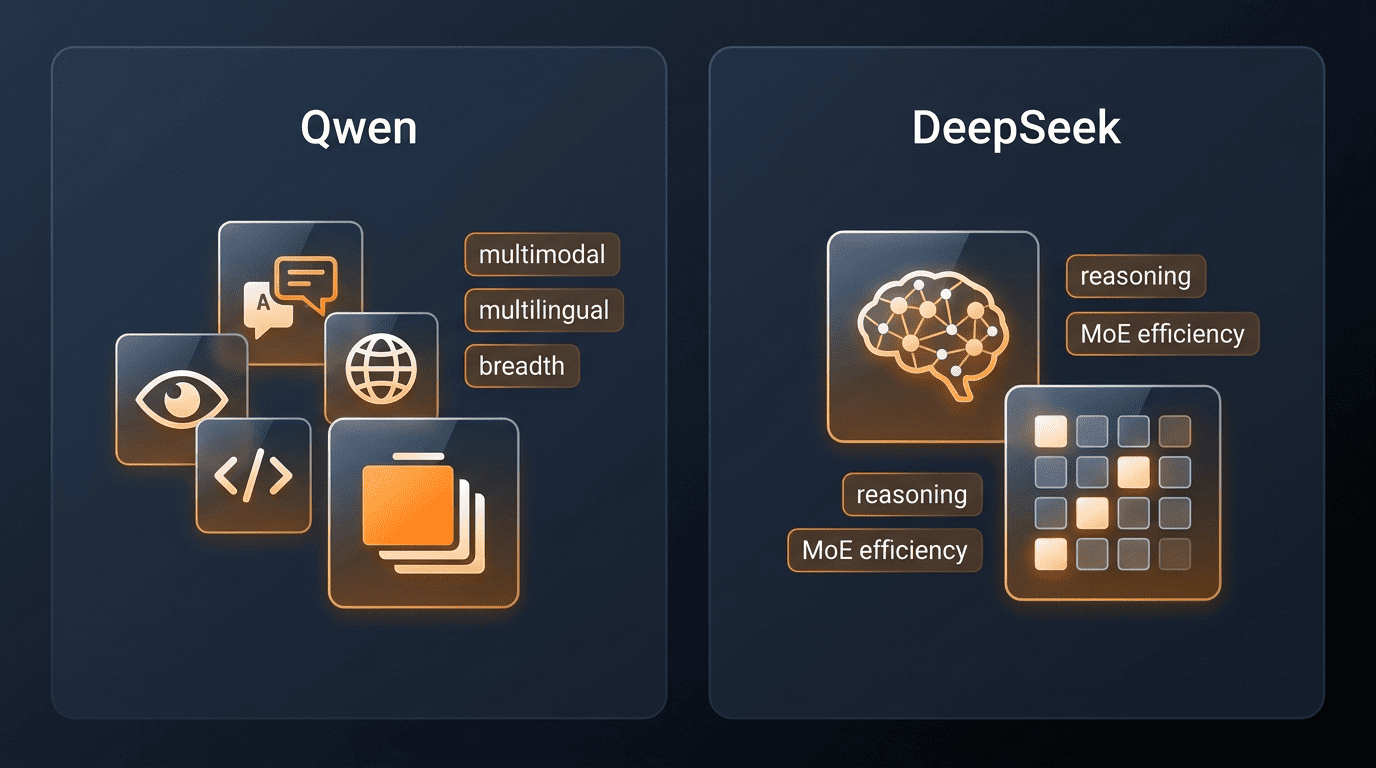
- Qwen’s breadth covers vision-language understanding through Qwen-VL, dedicated coding support through Qwen-Coder, audio processing, and support for a large number of languages, which Alibaba has described expanding across recent releases — always check the current model card for exact language coverage rather than relying on older figures.
- Qwen’s ecosystem advantage means one team can often stay inside a single family for chat, vision, and code tasks instead of stitching together multiple vendors.
- DeepSeek’s reasoning focus shows up most clearly in DeepSeek-R1, designed specifically for step-by-step reasoning across math, logic, and code problems.
- DeepSeek’s MoE efficiency in DeepSeek-V3 means only part of the network activates per token, an architectural choice aimed at efficient inference relative to a fully dense model of comparable scale.
Both families also show up frequently on open-weight leaderboards; specific rankings move often enough that citing a snapshot number here would be stale within weeks, so check the current standings on the relevant leaderboard directly rather than trusting a fixed figure from any single article.
Coding: How They Compare
Code generation and debugging are where both families get compared most aggressively, since coding tasks are easy to test yourself and hard to fake. Qwen ships a dedicated Qwen-Coder line built specifically for code completion, generation, and repair, while DeepSeek’s reasoning models — particularly DeepSeek-R1 — have built a strong reputation for algorithmic and debugging tasks that benefit from step-by-step reasoning.
Public benchmark comparisons between the two vary widely and often contradict each other depending on which test suite, prompt style, or model size is used, so treat any single leaderboard screenshot with caution. The most reliable approach is to test both directly on your own representative prompts:
- Pick 5-10 real coding tasks from your own codebase or backlog, not generic tutorial problems.
- Run the same prompts against a Qwen-Coder model and a DeepSeek-R1 model at comparable size tiers.
- Compare not just whether the code runs, but whether it matches your style, error handling, and dependencies.
- Test at least one multi-step debugging task, since that’s where reasoning-focused models often diverge from general coders.
- Check licensing on the specific model checkpoint before deploying either one commercially.
- Re-test periodically — both families update their coding-oriented releases regularly.
How Both Compare to the Closed Western Flagships
Qwen and DeepSeek are most often weighed against each other, but the more common real-world decision is an open-weight Chinese family versus the closed, proprietary frontier models from the big Western labs — most prominently OpenAI’s GPT-5.6 Sol and Anthropic’s Claude Fable 5. The difference is architectural and commercial rather than a single scoreboard.
- Access model. GPT-5.6 Sol and Claude Fable 5 are served only through their vendors’ hosted APIs — you cannot download the weights. Qwen and DeepSeek both publish downloadable open weights you can self-host, fine-tune, and run offline.
- Control and data residency. With the closed flagships, prompts leave your infrastructure by design; self-hosting Qwen or DeepSeek keeps data inside your own environment, which is often the deciding factor in regulated settings.
- Cost shape. The proprietary flagships are pay-per-token with no self-host option, while open weights shift the cost onto your own compute — cheaper at scale, more operational overhead.
- Frontier capability. GPT-5.6 Sol and Claude Fable 5 remain the reference points teams benchmark against for the hardest reasoning and agentic tasks; whether a given open-weight Qwen or DeepSeek checkpoint closes that gap for your workload is best judged on your own prompts, since public comparisons shift with every release. Treat any fixed ranking claim as provisional.
In practice the open-weight families and the closed flagships increasingly coexist in the same stack — teams route sensitive or high-volume traffic to a self-hosted Qwen or DeepSeek model and reserve GPT-5.6 Sol or Claude Fable 5 for the tasks where a frontier proprietary model still earns its per-token cost.
How to Access Each
Both families offer several access paths, from a hosted chat app down to fully local deployment, so the right choice depends on whether you need convenience, control, or cost predictability.
| Access method | Qwen | DeepSeek |
|---|---|---|
| Web chat | Qwen Chat | DeepSeek’s own chat app |
| Managed API | Alibaba Cloud Model Studio / DashScope | DeepSeek’s API |
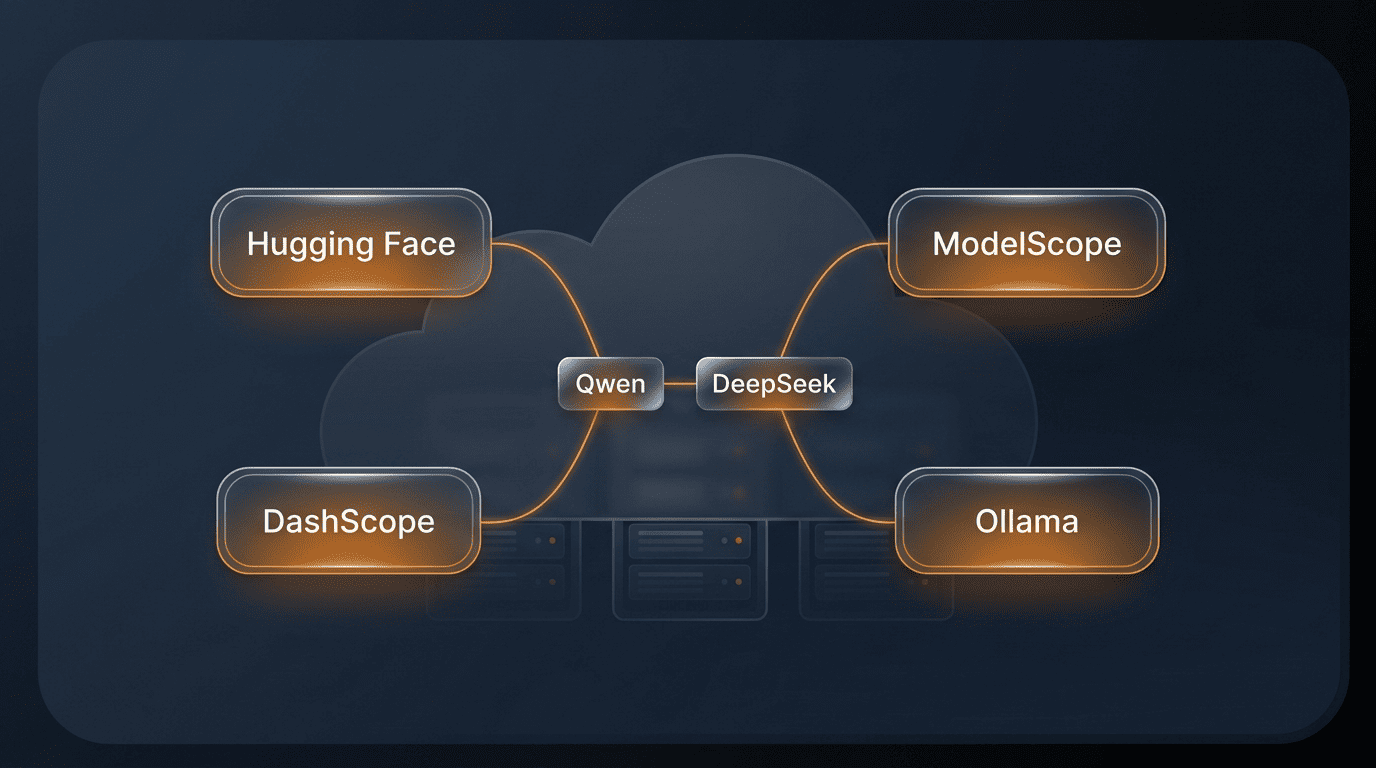
| Download weights | Hugging Face, ModelScope | Hugging Face |
| Local / self-hosted | Ollama, llama.cpp | Ollama, community runtimes |
Qwen access paths
Qwen is reachable through its own web chat application, through Alibaba Cloud’s Model Studio and DashScope for managed API access, and as open weights on Hugging Face and ModelScope for self-hosting. Local deployment is also supported through tools like Ollama and llama.cpp, which package the smaller Qwen model sizes for consumer hardware.
DeepSeek access paths
DeepSeek offers its own chat application and API directly from DeepSeek, alongside open weights published on huggingface.co/deepseek-ai for anyone who wants to run the models locally. As with Qwen, community-maintained runtimes and Ollama support make local deployment straightforward on suitable hardware. A number of third-party API hosting providers also serve both Qwen and DeepSeek models, which is worth checking if you want a single vendor relationship rather than going direct.
How to Choose Between Them
The right pick depends less on which family is objectively “stronger” and more on what your project actually needs — breadth and multimodality, or a tight reasoning focus.
- Pick Qwen if you want a broad family in one ecosystem — multimodal vision support, a dedicated coding line, wide language coverage, and a managed Alibaba Cloud API for production deployment.
- Pick DeepSeek if your priority is a focused, reasoning-heavy model with permissive MIT-licensed weights and a smaller surface area to evaluate.
- Remember it isn’t strictly either/or — many teams run both and route tasks to whichever model performs better for that specific job, since both are open-weight and can be self-hosted and evaluated side by side without a long procurement process.
FAQ
Unofficial. This site is not affiliated with, endorsed by, or sponsored by Alibaba or the Qwen team.