
Qwen2.5: Alibaba’s Widely Adopted Open-Weight Model Generation
Qwen2.5 is the generation of alibaba qwen models that turned Alibaba Cloud’s Qwen family into one of the most downloaded open-weight lineups in the world. Released by the Qwen team in September 2024, according to the official Qwen blog, it spans seven open sizes plus specialized coding, math and vision lines.
This page walks through what Qwen2.5 actually ships with: the size lineup, the licensing terms that apply to each variant, the specialized Coder/Math/VL/Omni lines, context length and language coverage, and the concrete ways to download or call the models. Unofficial. This site is not affiliated with, endorsed by, or sponsored by Alibaba or the Qwen team.
What Qwen2.5 Is
Qwen2.5 is the fourth major generation of Alibaba Cloud’s Qwen (Tongyi Qianwen) large language models, following Qwen, Qwen1.5 and Qwen2. The Qwen team pretrained the generation on up to 18 trillion tokens, according to Alibaba — a jump in training scale over earlier Qwen releases that the team credits for gains in general knowledge, coding and math ability.
The official announcement is explicit about the architecture behind the open releases:
All open-weight models are dense, decoder-only language models, available in various sizes.
Qwen Team, Alibaba Cloud
That single sentence rules out a common misconception: the open Qwen2.5 checkpoints are dense models, not mixture-of-experts. MoE shows up elsewhere in the family, but not in the downloadable dense sizes.
Where it sits in the Qwen timeline
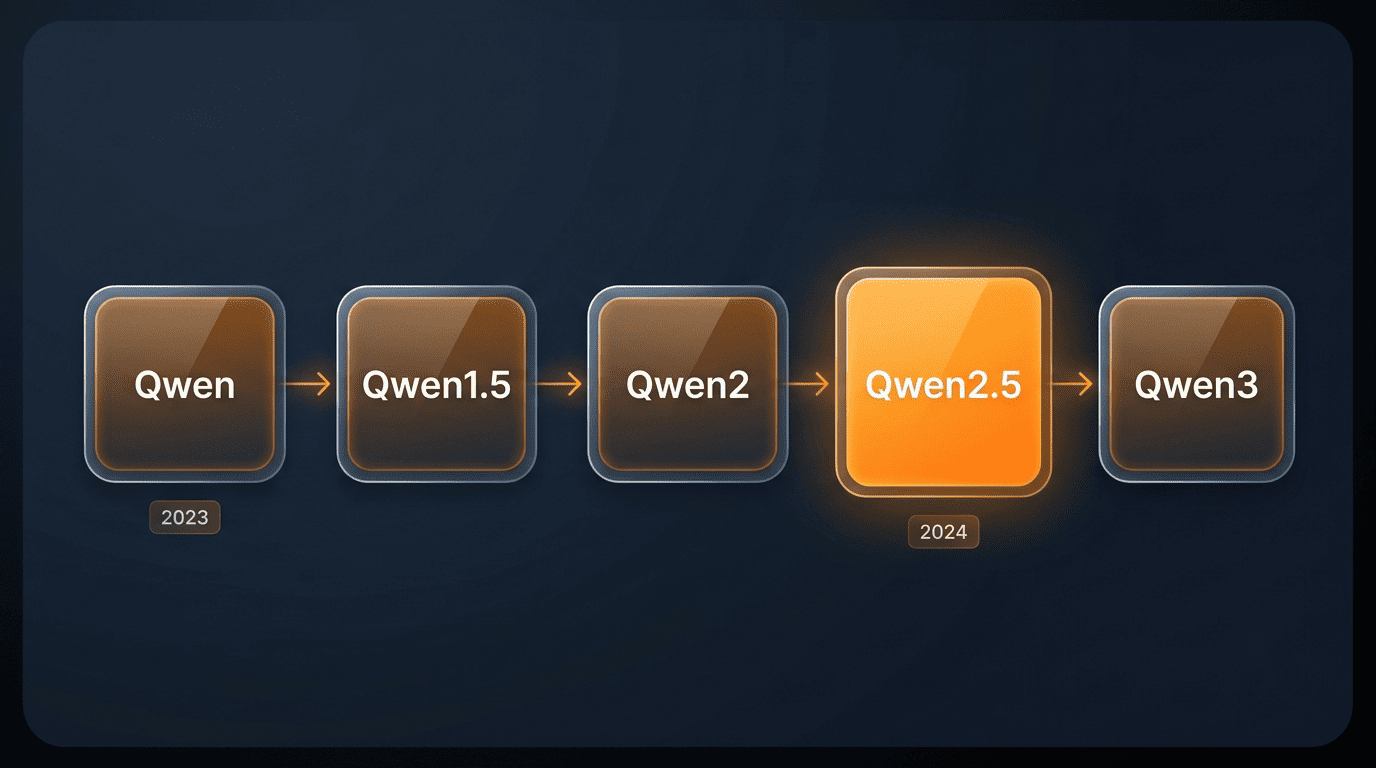
The lineage runs Qwen (2023) → Qwen1.5 → Qwen2 → Qwen2.5 (September 2024) → Qwen3, a later generation released after Qwen2.5. Each step added sizes, context length or training scale over the last. Qwen2.5 was, for a long stretch, the version most widely referenced in open-weight benchmarking and fine-tuning projects, in part because Alibaba Qwen2.5 shipped so many size and specialization options at once. This article covers Qwen2.5 specifically — exact Qwen3 specs are out of scope here and should not be assumed to carry over.
Model Sizes and Variants
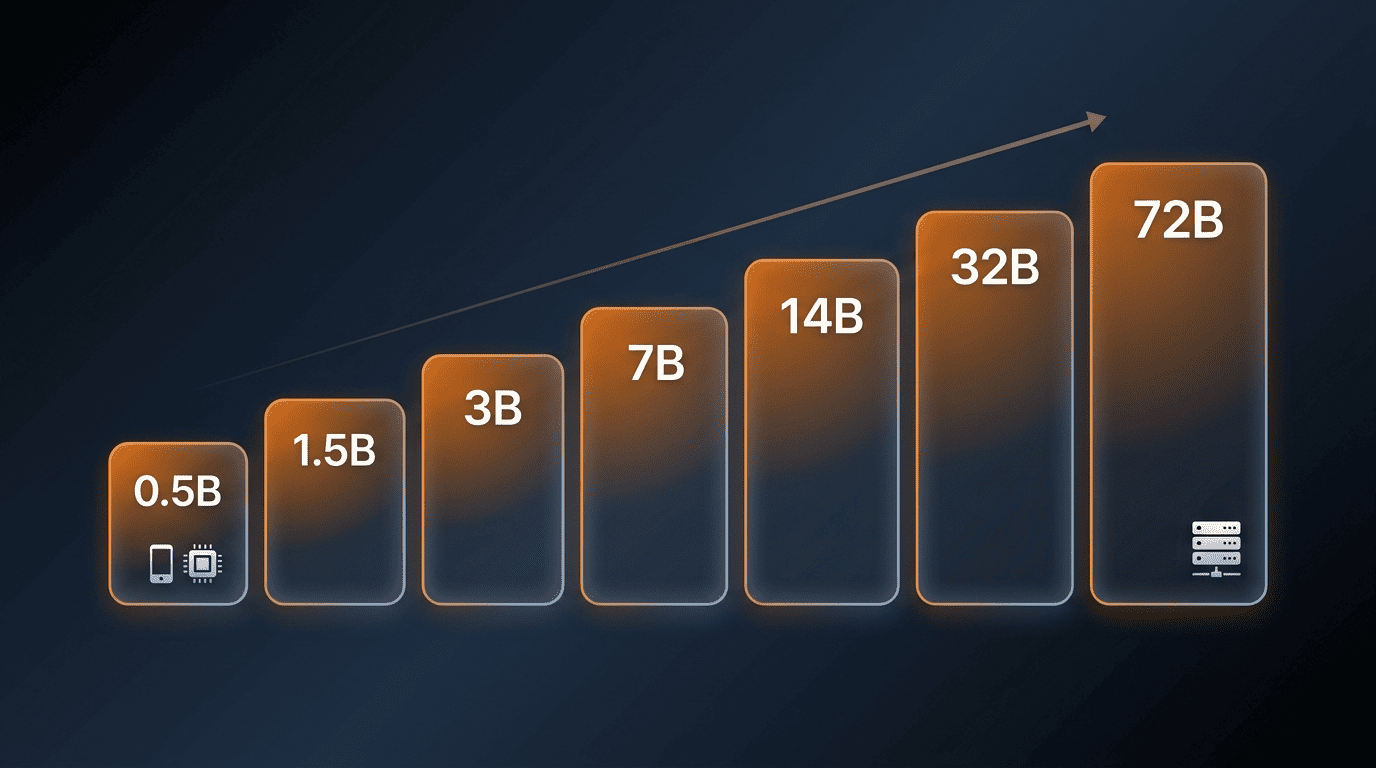
Alibaba Qwen2.5 does not ship as a single checkpoint. The open-weight line covers seven parameter sizes, each released as both a base model and an instruction-tuned model, and each also available in quantized builds (GPTQ, AWQ, GGUF) for lower-memory deployment. Separately, Alibaba operates hosted mixture-of-experts variants that are not distributed as open weights at all.
The seven open sizes
| Size | Typical fit | Ships as |
|---|---|---|
| 0.5B | On-device / edge, low-latency tasks | Base + Instruct, quantized builds |
| 1.5B | Lightweight assistants, mobile | Base + Instruct, quantized builds |
| 3B | Balanced small-footprint deployment | Base + Instruct, quantized builds |
| 7B | General-purpose local use | Base + Instruct, quantized builds |
| 14B | Stronger reasoning, still self-hostable | Base + Instruct, quantized builds |
| 32B | High-capability single-GPU/multi-GPU setups | Base + Instruct, quantized builds |
| 72B | Alibaba’s strongest open dense size in the generation | Base + Instruct, quantized builds |
The pattern across the table is straightforward: smaller sizes trade capability for speed and low memory footprint, making them suited to on-device or edge use, while the larger sizes target workloads that need stronger reasoning and can afford more compute. Alibaba does not publish a single “best” size — the right pick depends on the hardware budget and the task.
Hosted (proprietary) MoE options
Qwen2.5-Turbo, Qwen2.5-Plus and Qwen2.5-Max are hosted mixture-of-experts models served through Alibaba Cloud Model Studio (DashScope) rather than distributed as open weights. Qwen2.5-Turbo is advertised by Alibaba with context length up to 1M tokens, far beyond the 128K ceiling of the open dense models — useful for long-document or long-conversation workloads accessed purely through the API.
Open Weights and Licensing
“Open weights” for Qwen2.5 means the model files are downloadable and can be self-hosted, fine-tuned and run offline — but that does not automatically mean every size shares the same license terms.
Alongside the full-precision base and instruction-tuned checkpoints, Alibaba distributes quantized builds in several formats:
- GPTQ — post-training quantization for reduced memory footprint
- AWQ — activation-aware weight quantization
- GGUF — the format used by llama.cpp and compatible local runtimes
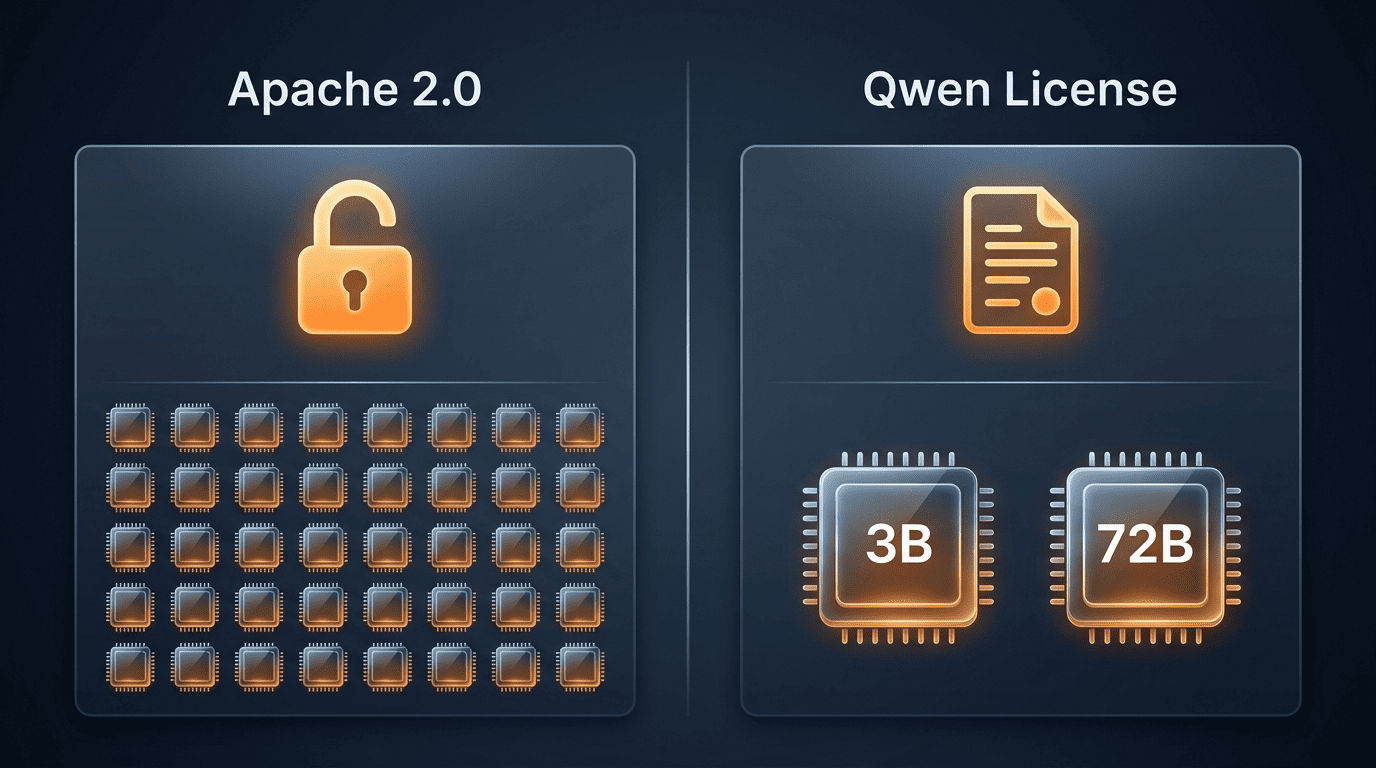
Most open sizes are released under Apache 2.0. That permissive license covers commercial use, modification and redistribution with minimal restriction, which is a large part of why Qwen2.5 saw such broad adoption in downstream projects. The 3B and 72B variants, however, are released under a separate Qwen license rather than Apache 2.0 — teams planning commercial deployment of those two specific sizes should read the license terms on the model card on Hugging Face before assuming Apache 2.0 terms apply. Treating the whole generation as uniformly Apache 2.0 is a mistake worth avoiding.
Specialized Lines: Coder, Math, VL
Beyond the general-purpose dense sizes, the Qwen team released task-specialized branches of the same generation.
- Qwen2.5-Coder — open coding models released across multiple sizes, positioned by Alibaba as competitive open-weight models for code generation, completion and repair tasks.
- Qwen2.5-Math — math-focused reasoning models tuned for solving and explaining mathematical problems.
- Qwen2.5-VL — vision-language models for image and document understanding, succeeding the earlier Qwen2-VL line.
- Qwen2.5-Omni — the end-to-end multimodal member of the family, built to handle text, audio, vision and video input together with speech output.
| Line | Focus | Modality |
|---|---|---|
| Qwen2.5-Coder | Code generation, completion, repair | Text/code |
| Qwen2.5-Math | Mathematical reasoning | Text |
| Qwen2.5-VL | Image and document understanding | Vision + text |
| Qwen2.5-Omni | End-to-end multimodal interaction | Text, audio, vision, video + speech |
Repositories and release notes for these specialized lines are maintained on QwenLM’s GitHub organization, alongside the general Qwen2.5 codebase.
Qwen2.5-Coder and Qwen2.5-Math in practice
Qwen2.5-Coder targets developers who want an open-weight coding assistant they can run locally rather than depend on a hosted API — code generation, autocompletion and bug-fixing are the stated use cases, described qualitatively by Alibaba rather than through a single published score. Qwen2.5-Math, by contrast, is aimed at problems requiring step-by-step numerical or symbolic reasoning, and is typically used as a specialized alternative to the general Qwen2.5 sizes when math accuracy matters more than general-purpose breadth.
Qwen2.5-VL and multimodal reach
Qwen2.5-VL extends the family into vision-language territory, built to read and reason over images and documents rather than text alone. Qwen2.5-Omni goes further still, folding audio and video into a single model that can also produce spoken output — the most end-to-end multimodal member of the Qwen2.5 generation.
Long Context and Multilingual Reach
Two practical numbers matter most for anyone evaluating Qwen2.5 for a real workload: how much text it can read at once, and how many languages it actually covers.
Context window
Open Qwen2.5 models support context length up to 128K tokens, with generation capped at up to 8K tokens per response, according to Alibaba. That’s the ceiling for anything run locally or self-hosted from the downloaded weights. The hosted Turbo variant, served only through the API, advertises a much larger context window — up to 1M tokens — for teams that need to process very long documents or extended conversation histories without chunking.
Languages
Alibaba states that the Qwen2.5 generation supports over 29 languages, including:
- Chinese
- English
- French
- Spanish
- Portuguese
- German
- Italian
- Russian
- Japanese
- Korean
- Vietnamese
- Thai
- Arabic
That breadth is one reason the qwen2.5 model family shows up in multilingual fine-tuning projects well beyond Chinese and English use cases — though, as with all capability claims here, the specific language count and quality are attributed to Alibaba’s own reporting rather than independently re-measured on this page.
How to Access Qwen2.5
There are two broad paths to using the Qwen2.5 series: download the weights and run them yourself, or call Alibaba’s hosted API.
Download the weights
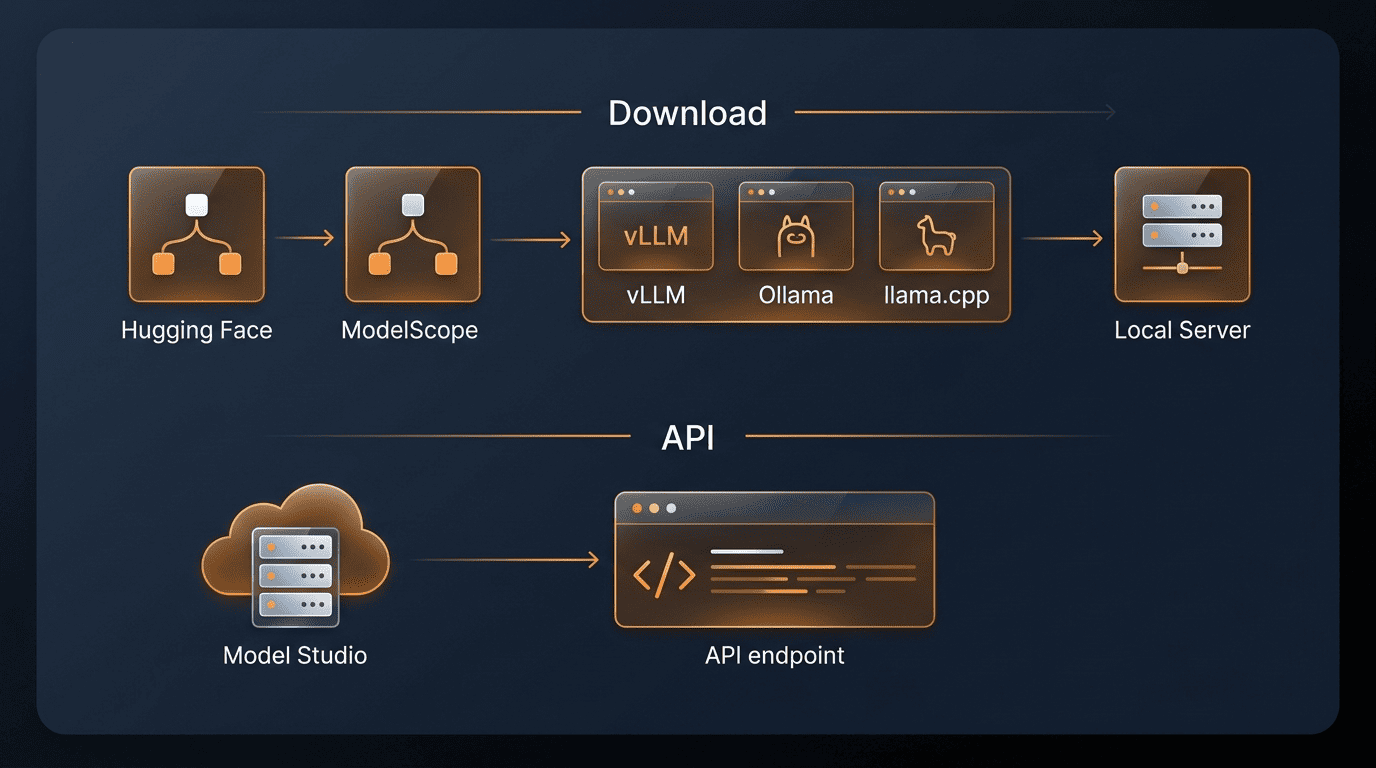
The open weights for the Qwen2.5 model family are hosted on Hugging Face and on ModelScope, Alibaba’s own model-hosting platform. From either source, the checkpoints can be run locally with common open-source serving tools.
To get a local Qwen2.5 model running, the typical path looks like this:
- Pick a size that fits the available GPU/CPU memory (0.5B–72B, or a specialized Coder/Math/VL/Omni checkpoint).
- Download the base or instruction-tuned weights from Hugging Face or ModelScope.
- Choose a serving runtime — vLLM, Ollama, or llama.cpp are the most commonly used with Qwen2.5.
- For constrained hardware, pull a quantized build (GPTQ, AWQ or GGUF) instead of the full-precision weights.
- Load the model in the chosen runtime and confirm the context window and license terms on the model card before deploying.
- For commercial use of the 3B or 72B sizes specifically, re-check the Qwen license terms rather than assuming Apache 2.0.
- Point applications at the local inference endpoint the runtime exposes.
Use the API
For teams that don’t want to manage inference infrastructure, Alibaba Cloud Model Studio (DashScope) serves Qwen2.5 through an API, including the hosted Turbo, Plus and Max MoE variants that are not available as downloadable weights. Alibaba also runs Qwen Chat (chat.qwen.ai) as a web interface for trying the models directly, and more background on the DashScope platform itself is available through Alibaba Cloud’s documentation.