
Tongyi Qianwen (通义千问): The Origin and Brand Behind Alibaba’s Qwen
Tongyi Qianwen (通义千问) is the original Chinese name of the large language model family that the world now knows as qwen alibaba — Alibaba Cloud’s flagship AI. According to Wikipedia, the two names refer to the same underlying models. In short: one product, two names, one Chinese and one international.
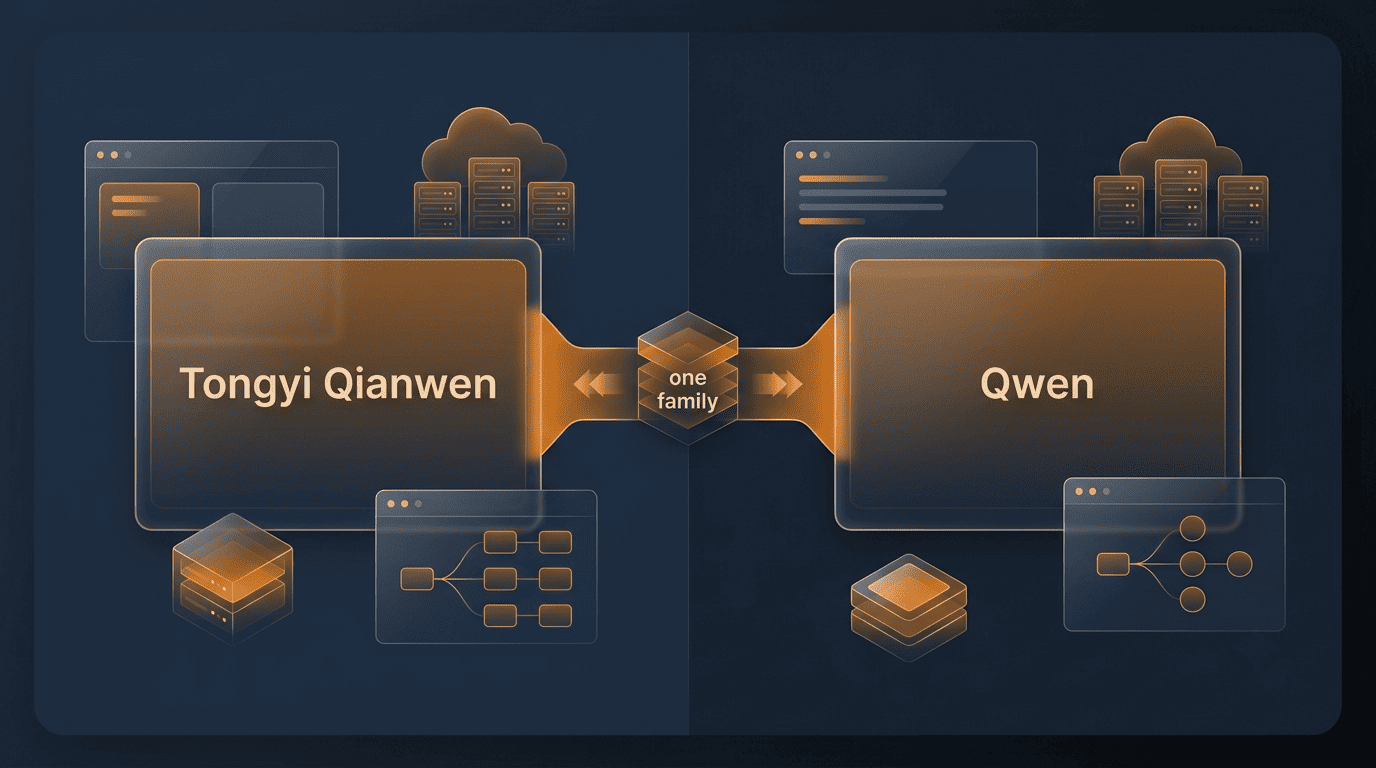
This article covers what the name means, the 2023 origin story, how “Tongyi Qianwen” became “Qwen” internationally, the broader Tongyi family it belongs to, and where it fits into Alibaba’s wider AI ambitions.
Disclaimer: Unofficial. This site is not affiliated with, endorsed by, or sponsored by Alibaba or the Qwen team. Model names, dates and quotes are attributed to their public sources; always confirm current details against Alibaba Cloud’s own documentation.
What Is Tongyi Qianwen?
The one-sentence definition
Tongyi Qianwen (通义千问) is a family of large language and multimodal models developed by Alibaba Cloud, the cloud-computing arm of Alibaba Group, according to Wikipedia’s entry on Qwen. It is the same family marketed internationally under the short name “Qwen.” Alibaba Cloud has expanded the lineup across several generations since 2023, and public detail on exact scale and benchmark scores should always be checked against the source rather than assumed.
What the name means
The name is written 通义千问, pronounced Tōngyì Qiānwèn in Mandarin. It breaks into two recognizable parts: 通义 (tongyi), roughly “shared” or “general meaning,” and 千问 (qianwen), literally “a thousand questions.” Put together, the commonly cited loose translation is something like “understand the meaning, [and answer] a thousand questions” — a description of the product’s aim rather than a technical specification. Chinese tech press and Alibaba’s own materials use this framing when introducing the name to non-Chinese-speaking audiences.
Tongyi Qianwen vs. Qwen: One Family, Two Names
Two names for one model family can be confusing at first glance, especially since English-language coverage almost always defaults to the shorter one.
Why two names exist
“Tongyi Qianwen” is the Chinese-market product name, used in Alibaba’s domestic announcements, press releases and consumer-facing branding in China. “Qwen” is the compact, romanized brand used in the code repositories, on Hugging Face, and in international communications. The official GitHub repository makes the pairing explicit in its own description, identifying itself as “the official repo of Qwen (通义千问) … proposed by Alibaba Cloud,” as documented at github.com/QwenLM/Qwen. Read this way, “Qwen” functions almost like an abbreviation of “Qianwen,” dropped of tones and vowels for easier global use.
Table: the naming at a glance
| Name | Script/Origin | Where It’s Used |
|---|---|---|
| 通义千问 | Chinese, original product name | Chinese-market branding, domestic press |
| Tongyi Qianwen | Pinyin romanization | English-language coverage of the Chinese product |
| Qwen | Short international brand | GitHub repos, Hugging Face, model cards, Qwen Chat |
| Tongyi (通义) | Umbrella brand | Covers Qianwen (LLM), Wanxiang (image) and other Alibaba foundation models |
History: From 2023 Launch to an Open-Weight Family
Qwen’s public history is well documented and starts, like much of the current generative-AI wave, in 2023.
The 2023 origin
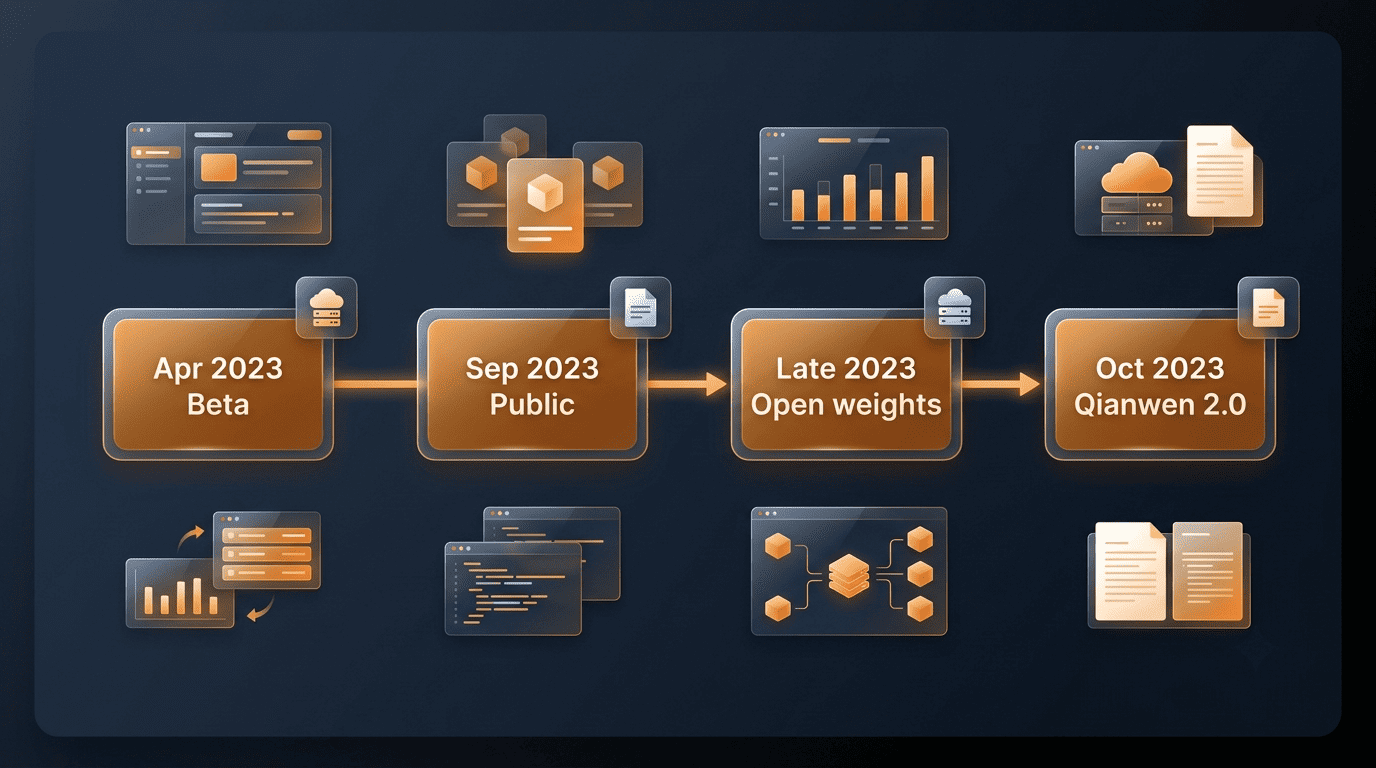
Alibaba unveiled a beta of Tongyi Qianwen in April 2023 and opened it to the public in September 2023 after clearing Chinese regulatory approval. These dates mark Alibaba as one of the earlier Chinese big-tech entrants in the generative-AI race, alongside a wave of domestic competitors racing to bring large models to market that same year.
First open-weight releases
The Qwen team began publishing open model weights later in 2023: Qwen-7B on August 3, Qwen-14B on September 25, and then Qwen-72B together with the smaller Qwen-1.8B on November 30 — each shipped with an aligned -Chat variant for instruction-following use. These releases and their accompanying technical report are documented in the official QwenLM repository. Later version numbers should not be assumed beyond what Alibaba has confirmed publicly.
Tongyi Qianwen 2.0 at Apsara
On October 31, 2023, at the annual Apsara Conference in Hangzhou, Alibaba Cloud announced Tongyi Qianwen 2.0 along with a set of industry-specific models. The announced set spanned several verticals at once:
- Customer support
- Legal counselling
- Healthcare
- Finance
- Documentation management
- Audio & video management
- Code development
- Character creation
The announcement placed Qwen at the center of Alibaba Cloud’s broader enterprise AI push, positioning the model family as infrastructure other companies could build on rather than a standalone consumer product.
Here is how Alibaba Cloud’s own leadership framed the ambition at that event:
Currently, 80% of China’s technology companies and half of large model companies run on Alibaba Cloud. We aim to be the most open cloud in the era of AI.
Joe Tsai, Chairman of Alibaba Group, Alibaba Cloud blog
That framing — an “open cloud” strategy built around AI infrastructure — helps explain why so much of the Qwen lineup, unlike some competing labs, ended up with open weights rather than staying closed behind an API alone.
The Qwen Model Lineage
Since the initial 2023 releases, Alibaba has iterated through several confirmed generations of the model family.
Generations
The confirmed lineage runs from Qwen (1.0) through Qwen1.5, Qwen2 and Qwen2.5 to the current Qwen3. Across these generations, Alibaba and the QwenLM team describe a general trend toward broader language coverage, larger context handling, and more permissively licensed releases — though exact benchmark figures and parameter counts vary by model and should be checked against current release notes rather than treated as fixed. The QwenLM blog is the place to track official release logs as they’re published.
Specialized lines
Beyond the general-purpose chat models, Alibaba has released several specialized branches under the Qwen name:
- Qwen-VL — a vision-language line for image-and-text tasks
- Qwen-Audio — a line focused on audio understanding
- Qwen-Coder (including Qwen2.5-Coder) — models tuned for code generation and understanding
- Qwen-Math — models tuned for mathematical reasoning
- QwQ — a reasoning-focused line
These branches ship across a wide range of sizes, from small models suitable for local or edge deployment up to much larger dense and mixture-of-experts (MoE) configurations, rather than a single fixed size ladder. Tracking this lineup generation by generation is the fastest way to understand qwen by alibaba as it stands today.
The Broader Tongyi Family
Tongyi Qianwen does not stand alone inside Alibaba — it is one member of a larger branded initiative.
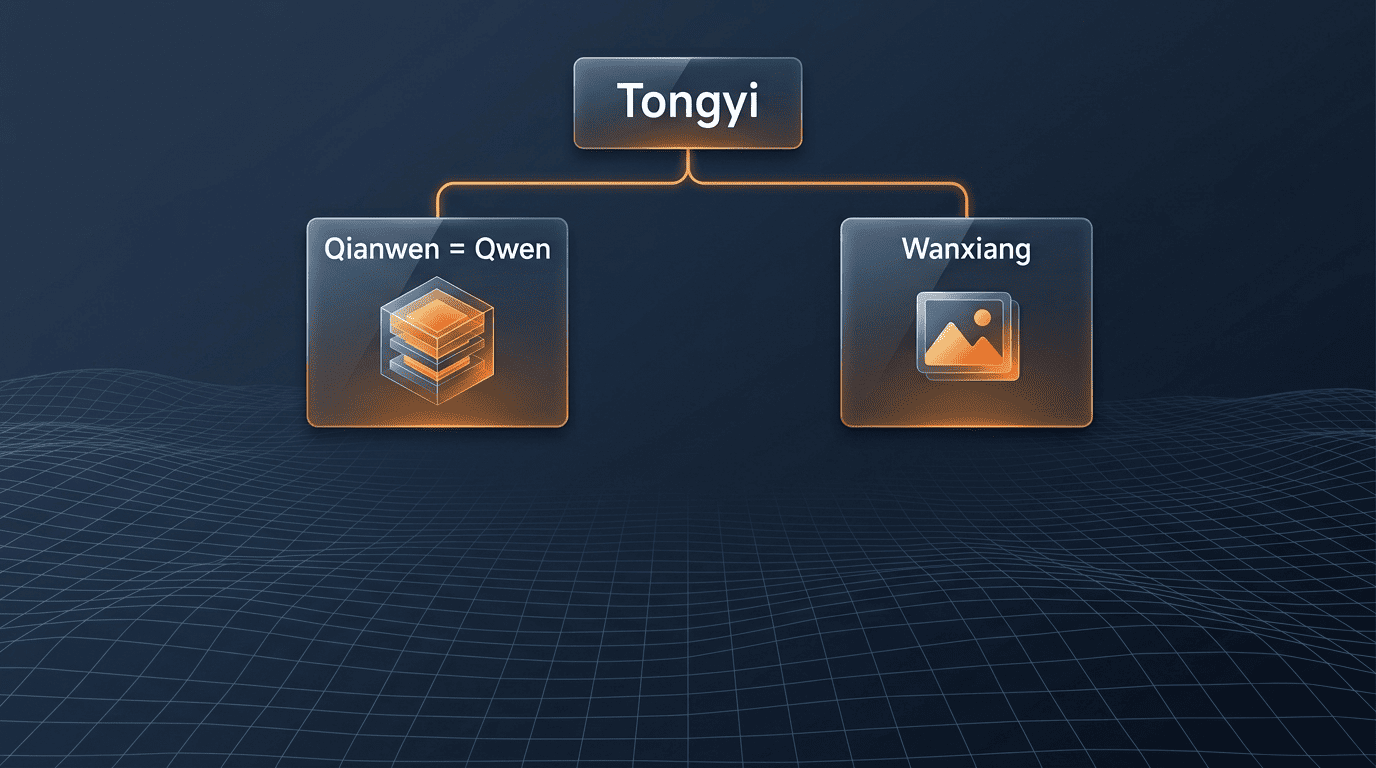
Tongyi (通义) is the umbrella, Qianwen is one member of it. The Chinese term 通义, meaning roughly “general meaning,” is Alibaba’s brand for its whole foundation-model program. Tongyi Qianwen — the text and multimodal LLM family known internationally as Qwen — is by far its best-known and most widely used member, but it sits alongside other models under the same umbrella rather than being synonymous with it.
Tongyi Wanxiang is the most commonly cited sibling. Tongyi Wanxiang (通义万相) is Alibaba’s text-to-image and visual-generation model, built and branded under the same Tongyi umbrella as Tongyi Qianwen, but developed as a separate product for image generation rather than as part of the Qwen LLM series. Beyond Wanxiang, Alibaba has not published a full public catalog of every Tongyi-branded product, so this article keeps to what is well established rather than listing unconfirmed names.
Open Source and Licensing
Licensing is one of the more practical questions for anyone evaluating Qwen for a real project, and it varies by model rather than following one blanket rule.
Three licensing regimes
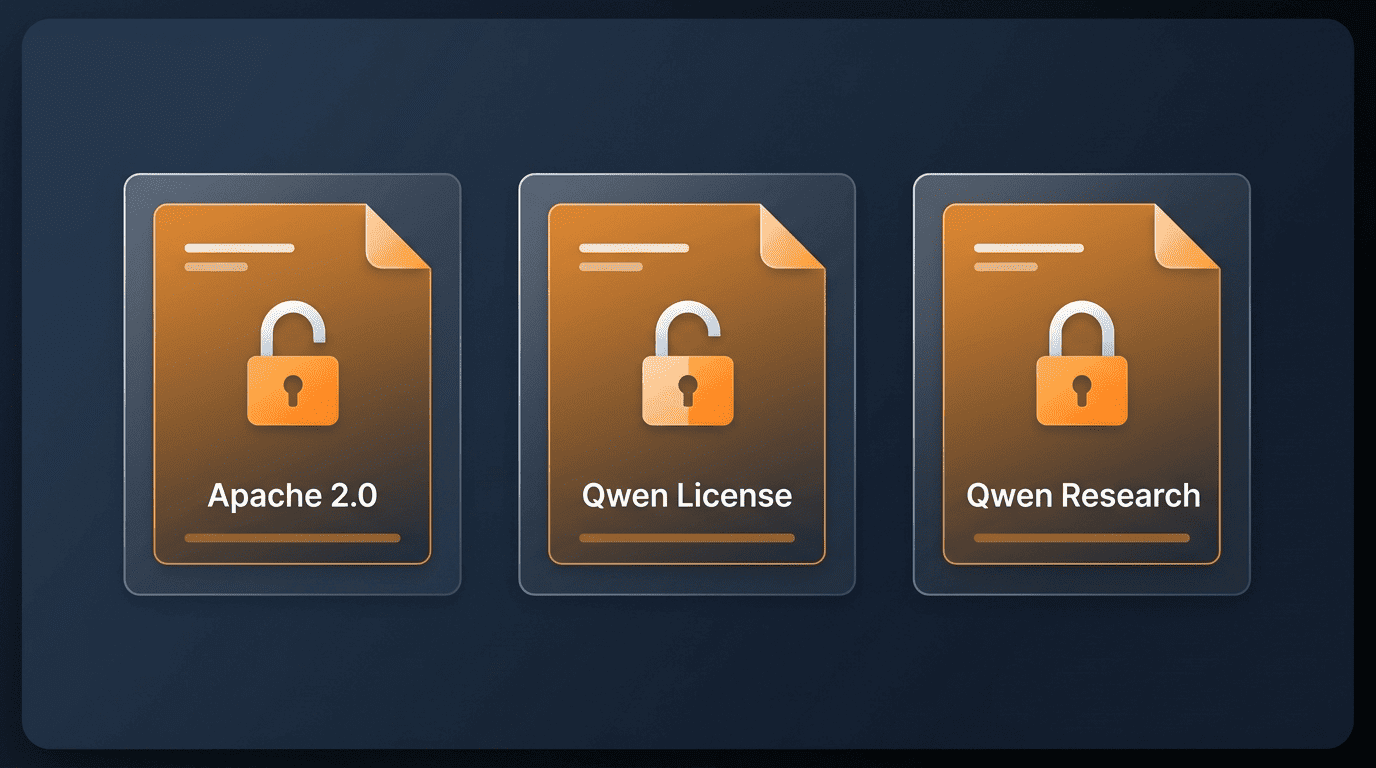
Qwen models are released under three broad regimes:
- Apache 2.0 — a fully permissive open-source license, used for many of the smaller and mid-sized models
- Qwen License (sometimes referred to as the Tongyi Qianwen License) — source-available, permitting use under more conditions than Apache 2.0
- Qwen Research License — restricted to non-commercial, research use only
The largest and newest models are sometimes offered only through Alibaba Cloud’s own API rather than as downloadable weights at all. Because the license differs model by model, checking the specific model card before use is the only reliable approach.
| License | Type | Typical Use |
|---|---|---|
| Apache 2.0 | Permissive open source | Commercial and research use, including fine-tunes and redistribution |
| Qwen License | Source-available | Use permitted under Alibaba’s specific terms; check conditions per model |
| Qwen Research License | Non-commercial | Academic and research use only |
| Alibaba Cloud API only | Proprietary, hosted | Access via DashScope/Model Studio; no downloadable weights |
Where to get the weights
- Visit huggingface.co/Qwen, the official Qwen organization page on Hugging Face.
- Browse by model family (Qwen, Qwen-VL, Qwen-Coder, etc.) to find the size and variant needed.
- Check the model card for the specific license — Apache 2.0, Qwen License, or Qwen Research License.
- Alternatively, browse the same releases on ModelScope, Alibaba’s own model hub.
- Download weights directly or load them through a compatible inference framework.
- Confirm commercial-use terms against the license before deploying in production.
This open-weight strategy — publishing usable model weights rather than keeping everything behind a paid API — is a significant part of why Qwen became a popular base for community fine-tunes.
The Alibaba Cloud AI Ecosystem
Qwen is not delivered through a single channel; Alibaba Cloud has built out a small ecosystem of platforms around it.
How Alibaba delivers Qwen
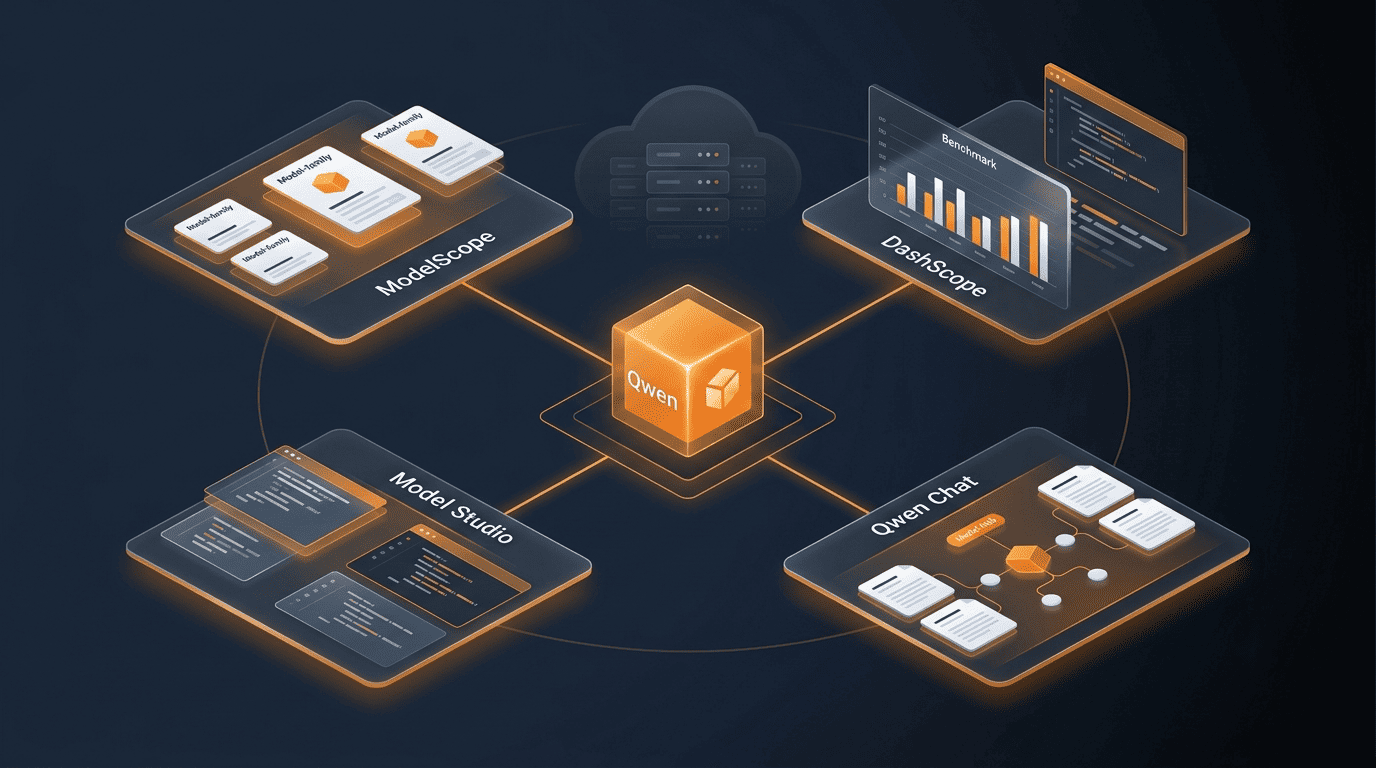
- ModelScope — Alibaba’s own open model hub, used for browsing and downloading model weights, similar in role to Hugging Face
- DashScope — Alibaba Cloud’s model-serving API for Qwen, exposing hosted model variants such as qwen-turbo and qwen-plus for applications that don’t want to self-host
- Model Studio — Alibaba’s generative-AI development platform (also referred to as Bailian) for building applications on top of Qwen and related models
- Qwen Chat — the consumer-facing chat application, available at qwen.ai / chat.qwen.ai, for people who just want to talk to the model directly
Together these four pieces cover the full path from raw open weights to a polished consumer chat product, without requiring any single entry point.
Alibaba’s Position in AI
Zooming out, Tongyi Qianwen is also a data point in how Alibaba positions itself relative to other major AI labs.
An open-weight strategy as a competitive bet. By releasing much of the Qwen family as open weights rather than keeping it fully closed, Alibaba Cloud made Tongyi Qianwen one of the more influential open-weight bases in the broader AI ecosystem — Qwen derivatives are commonly found on Hugging Face, built by developers and companies fine-tuning the released weights for their own use cases. This lines up with the “most open cloud” framing Joe Tsai used at the 2023 Apsara announcement quoted above: rather than compete purely on a closed, proprietary model, Alibaba Cloud has leaned on openness as differentiation. Specific adoption figures or leaderboard rankings change quickly and should be checked against the relevant leaderboard directly rather than assumed from older coverage.
Anyone comparing Alibaba’s models against other AI labs will find that this openness — open weights, multiple license tiers, and hosting on both Hugging Face and ModelScope — is one of the more consistent threads running through the whole Tongyi Qianwen story, from the first Qwen-7B release in 2023 through to the current generation.
For a closer look at how the alibaba qwen models lineup has evolved generation by generation, Alibaba’s own release channels remain the most reliable reference point.